You’ve Been Hacked!

government spying, cell phone, mobile phone, law enforcement surveillance

(photo: upload.wikimedia.org)

So how do cops and spooks steal data from your mobile phone, anyway? Research teams at the Kaspersky Lab in Russia and Toronto’s Citizen Lab independently analyzed a digital surveillance tool created by the Italian Company, Hacking Team (do watch this marketing video if you want something to think about), which more than 60 government worldwide use to snatch and record mobile phone data. The tool’s components have been designed to target Android, iOS, Windows Mobile, and BlackBerry users—one of whom is probably you.

According to a lengthy Wired article by Kim Zetter, here’s what the Hacking Team’s tool can do: collect your emails, text messages, call history, and address books; log keystrokes, reveal where you’ve searched, and take screenshots; record audio of calls and the ambient sounds in the room where the phone is; and use the phone’s camera to take pictures of the surroundings. No surprise, the tool can use the phone’s GPS system to locate it (and probably, you, too). In other words, the tool can do with the phone pretty much everything you can.

What’s new about these revelations is that this is the first time these techniques have been reverse-engineered to reveal how they really work, including how they protect themselves from detection. Here’s a blog post about these discoveries from Russian researcher Sergey Golovanov.

film noir, spies

(photo: c1.staticflickr.com)

Spies following each other through the wetly reflecting nighttime alleys of Eastern Europe will be relegated to film noir, since the above functions let a tracker follow you to that screening of 1984 and home again from some remote center. Most countries using this technology have one or two command-and-control centers to monitor multiple targets and conduct surveillance. The nation with by far the most such centers? The United States, with 64.

The genie is out of the bottle, however, and “This type of exceptionally invasive toolkit, once a costly boutique capability deployed by intelligence communities and militaries, is now being marketed for targeting everyday criminality and ‘security threats,’” say Citizen Lab researchers. Inevitably, people who shouldn’t have it, will.

****Spycraft

Desmond Llewelyn, Q, James Bond, Spycraft

Desmond Llewelyn as “Q” (photo: wikimedia.org)

By Robert Wallace, H. Keith Melton, and Henry Robert Schlesinger. Foreword by George Tenet, narration by David Drummond. The digitization and miniaturization everywhere in our daily lives has affected tradecraft in the espionage world, too—and sometimes began there before entering the consumer market. Initially, the CIA tried to heavily censor Spycraft: The Secret History of the CIA’s Spytechs, from Communism to Al-Qaeda, but eventually ended up making almost no changes. The book details the history of the Agency’s Office of Technical Services—the department that, since World War II, has come up with all the dead drops, audio surveillance techniques, secret inks, espionage gear, and so on needed by field agents. Q, in other words.

Co-authored by a former OTS director, Spycraft begins with a review of cases involving some of the most notorious and significant, mostly Soviet, spies run by the CIA, then turns to a detailed review of various spycraft essentials and what makes them work—or not—in the field. The history of the Soviet spies, most of whom were discovered and executed, provides an appreciation for the steady improvements in technology, though it’s pretty much a mug’s game, because improvements in detection soon follow. The challenge is to remain one step ahead. I didn’t come away with a satisfactory answer to the key question: with all this amazing technology, how come the CIA has missed the big plays? 9/11, Iraq’s true WMD situation, the Arab Spring?

For anyone writing spy and espionage fiction, Spycraft summarizes innumerable backstory issues and technical details that must be right! But beyond these specifics, the choice of what OTS worked on and how the technical officers solved problems reveals the dilemmas faced by field agents. Other readers may simply be amazed at the scope and persistence of this clandestine effort. (Amazon reader rating: 4.5 stars.)

*****His Excellency: George Washington

George Washington

General George Washington at Trenton by John Trumbull

By Joseph J. Ellis–Historical figures go in and out of fashion like men’s wide lapels, and I must have had my little exposure to George Washington during one of his dreary periods, because, well, yawn. This book was a revelation. It presents Washington in a balanced light, including his flaws, though the author is obviously a fan. With two Pulitzers to his credit (for Founding Brothers and American Sphinx, a biography of Thomas Jefferson), Ellis knows his early American history. I had a timely trip to nearby Monmouth Battlefield—where “Molly Pitcher” pitched in—which made the Revolutionary War period of Washington’s career come further alive.

Because mammoth biographies of Washington already exist, and his papers and letters have been preserved and cataloged, “The great American patriarch sits squarely in front of us: vulnerable, exposed, even talkative at last.” Thus Ellis’s purposes were to create a biography of modest size (275 pages), not another in an “endless row of verbal coffins,” and to put Washington in clearer context with respect to revolutionary ideology, social and economic forces, the political and military strategic options of 1776, slavery, and the fate of the Indians. The result is an eminently readable story that I expect will provide every reader with new insights about the supremely human Father of our country.

At Least Someone’s Paying Attention

texting while driving

(photo: activerain.trulia.com)

Video about texting and driving grabs teens’ attention (link below). In the last weeks I’ve been driving the Interstates and major highways in three northeastern states and one Canadian province. From this limited cruise, only New York State showed evidence it is tackling the dangerous practice of texting while driving. We’re all familiar with the roadside “rest stops”; now NYS has added “text stops,” announced with frequent signs like “It can wait: Text stop 5 miles.” These areas are pretty close together, too, at least on Interstate 81. In some places, they’ve added “text stop” signage above existing rest stop signs, but in others, they’ve created a quarter-mile lane for cars or trucks to pull off the highway, send that vital text message, and pull back on. For what can happen when you don’t, see this absolutely brilliant video.

Truthfully, I didn’t see very many people pulled over to text, but planting the seed that there’s a time and place for texting is a worthy effort that may have a long-term impact. Better that than the kind of impact pictured above.

Automotive Report: LeMans Update

car

(photo: author)

UPDATE: There’s a link to pix of last weekend’s 24-hour LeMans race, below, but New Jersey cars, not to be outdone, show real personality! The most recent parking lot find: the eyelash car. Remember the cars whose headlights would rotate closed when not in use? One of them wouldn’t be working right and would close only partway, making the car look half-asleep, when in New Jersey, that privilege is reserved for the driver.

carI’m intrigued by what the person with the do-it-yourself woodie is trying to accomplish.

Is he creating a lumber exoskeleton to give his vehicle some extra protection from his fellow drivers? Pointing out the inadequacy of materials or imagination in Toyota’s design? Making an artistic statement? And, is the upside-down Toyota emblem an international symbol of automotive distress?


Plastic Guns

meteor

(photo: c1.staticflickr.com)

In the hands of a good mystery/thriller writer, the presence of undetectable plastic guns can change the dramatic equation. But in case the real-life possibility of seriously lethal 3-D printed guns existing outside the weakly regulated firearms marketplace has been a problem barely on the edge of your consciousness, a threat like a massive meteor strike—remote, but awful—it’s time to give it further thought. A Wired article by Andy Greenberg, full of anonymous sources and YouTube videos of test-firings, shows how far this technology has come. Predictably, the cost of manufacture has plummeted as lethality has risen.

A combination of libertarians, gunsmiths, and technology enthusiasts has been improving on printable handgun and rifle designs, step-by-step, moving “3-D printed firearms from the realm of science fiction to practical weapons.” And, Greenberg says, leaving “legislators and regulators in the dust,” despite the Undetectable Firearms Act. Another reason this situation is like a meteor strike is, given what we know—in this case about human behavior—these developments seem unstoppable.

The RFID article below suggests how a different technology can contribute to gun safety, too, for conventional handguns.

History is Personal

Edwards, Wilson County

Edwards graveyard, Wilson County, Tenn. (photo: author)

A trip to the New York Public Library’s Milstein Division this week with three friends was a chance to catch up on the progress we’re making with our family genealogies. Each of us has made surprising discoveries—a grandfather who, as a baby, was left at the doorstep of a foundling hospital; Tennessee Civil War veterans who lived the agonizing struggle of “brother against brother”; the ancestor who lived next door to the real-life House of the Seven Gables in Salem, Massachusetts, and was a member of the Salem Grand Jury two decades before the witch trials; the family grave markers revealing sons who died within days of each other in the 1918 influenza outbreak. I even know the names and a bit of the history of the ships that brought some of my ancestors to America in 1633 and the early 1900’s (Griffin, Kaiser Wilhelm II, and Amerika).

All writers can find inspiration in history, says a recent blog on the Writer magazine website by Hillary Casavant. From my own experience, looking at lives reduced to a few lines transcribed from some 180-year-old deed book, or the estate inventory that includes not only “a cowe and hoggs,” but also salt, pepper, and a coffee pot makes you think about what was valuable in a person’s life generations ago. (As a measure of changing living standards, my household has four coffee-pots and three tea-pots. No cowe or hoggs, though.)

These shards of insight prompt the thought, “I’d like to know the story behind that.” Just such an impulse set a writing colleague on a path to research one of her ancestors, born in the late 1800’s—the first woman to serve as a probation officer in the London criminal courts. Information is scattered, and she has the challenge of writing a fictionalized history. Another writer friend is compiling a set of essays on her family’s history that is closer to a conventional memoir, but viewed through a psychological lens—a thoughtful analysis of how a father’s treatment of his sons echoes through the family generations later.

Writers use history in many different ways to “make it real.” From my recent reading, additional examples are Robert Harris’s An Officer and A Spy, a novelization of the infamous Dreyfus case, in which all the players are known, and the mystery The Cold, Cold Ground by Adrian McKinty, which uses the hunger strikes in Northern Ireland’s HM Prison Maze not only as a backdrop but weaves it into the actions and motivations of the fictional characters. Movies plow this ground endlessly. I really enjoyed The Monuments Men, which, although it prompted inevitable historical quibbles, stayed closer to real experience than the more highly fictionalized The Train, the 1964 Burt Lancaster/Paul Scofield movie on the same theme, which I saw again on TV last night. (Illustrating how far from real life Hollywood must sometimes stray, Wikipedia reports that Lancaster injured his knee playing golf, and to explain his limp, the movie added a scene in which he is shot while crossing a pedestrian bridge. Also, the executions of a couple of characters occurred because the actors had other “contractual obligations.”)

Casavant provides links to websites that can provide historical inspiration, including the

lists of history facts in Mental Floss, a blog of noteworthy letters, and the Library of Congress’s 14.5 million photo and graphic archive. To her suggestions, I’d add that one’s own family history, the unique combinations of external events and internal dynamics that made them who they were, can also be a rich resource. In a sense, it’s a recasting of the much-abused advice to writers to “write what you know.” Or, as George Packer has said (his ancestors lived adjacent to mine on Hurricane Creek in Wilson County, Tennessee, BTW), “History, any history, confers meaning on a life.”

**** The New York Nobody Knows

Chinatown, New York

(photo: wikimedia.org)

By William B. Helmreich, a CUNY sociologist, who writes about his 6,000-mile walk along almost every block of New York’s five boroughs. He spends a lot of real estate talking about how that’s the only “real” way to see the city—no need to convince me! It’s a fascinating exploration of various themes, including gentrification, ethnicity, and community activity. The result is a kind of compendium of urban diversity, rather than the more usual portrait of individual neighborhoods. Absolutely fascinating.

The author is a genial-looking sort who is apparently game to talk to just about anyone about just about anything, especially their local community. He is perpetually impressed with the gumption of the people he meets, and his genuine curiosity prompts responses worthy of pondering.

Buying a bottle of water on a hot day from a young Hispanic street vendor, Helmreich asks, “How do you keep these bottles cold out here?” “Well, first I freeze them at home. That way they stay cold a long time.” “Where are you in school?” “I just graduated high school.” “What are you gonna do next?” “I’m going to Monroe College.” “For what?” “I’m going to be a rich businessman. It’s a great college.” New York spirit. Helmreich loves it, and so will you.

Eastern State Penitentiary

Eastern State Penitentiary, prison, isolation

Eastern State Penitentiary, Philadelphia (photo: author)

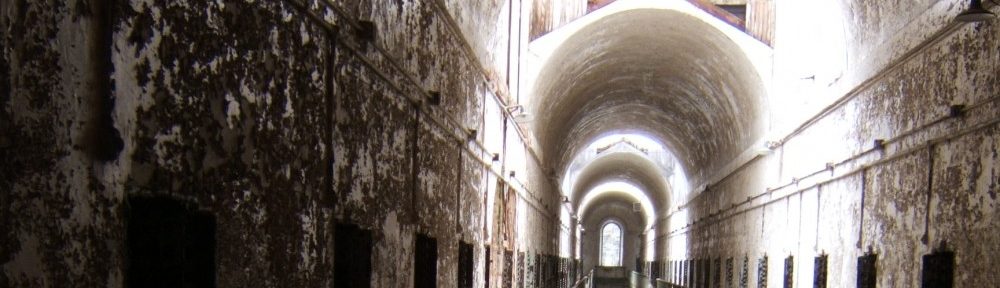
Many East Coasters recognize the photo featured on this website home page as taken inside the crenelated walls of Eastern State Penitentiary. A “model” institution when it was built outside Philadelphia in the early 1820’s, Eastern Pen remained in use until 1970, by which time officials deemed it “not fit for human habitation.” Governing magazine’s David Kidd recently created a photo essay about this crumbling institution, now near the city’s downtown.

Although the felons have left, today Eastern Pen is a tourist attraction and hosts concerts and other events. If you visited it today, May 10, you could attend a reunion of inmates and guards, who would answer your questions about their former lives there. Every fall, it hosts Terror Behind the Walls, “a massive haunted house in a real prison.”

Kidd points out that the Quakers who built Eastern Pen originally constructed only single-person cells, so that miscreants would have absolute solitude to reflect on their crimes and on the Bible. This, the founders believed, would make men truly penitent (“penitentiary”). In this original sense, a penitentiary differed from a prison, where convicts mingled and shared cells. From the time a prisoner entered Eastern Pen and was led to his cell (wearing a hood) until the time he left (also hooded), he never saw or spoke to another human being. Later, with more crowding, that changed.

The city fathers were proud of their innovation and eagerly showed it to visitors, one of whom was Charles Dickens. Dickens was horrified at the suffering he believed this total isolation would produce. He was inspired to replicate it in A Tale of Two Cities, where the solitary cell in the Bastille drove his character, Dr. Manette, insane.


Enhanced by Zemanta

White House Humor

White House

(photo: pixabay.com)

New York magazine has collected the “best” humor from some sixty years of White House Corrrespondents’ dinners. Some painful reads there! An example from our current President: “These days I look in the mirror and I have to admit I’m not the strapping young Muslim socialist I used to be.” That was 2013. This year he said, “These days the House Republicans actually give John Boehner a harder time than they give me, which means orange really is the new black.” The writing has definitely improved over the years. Going back seven or eight administrations, you have to wonder, why were these people laughing?

This year’s dinner received the perennial criticism from some journalists, including Bob Garfield of NPR’s On the Media, who thinks the dinner is a violation of the separation of source and reporter, from his position on the outside, looking in.