A Song at Twilight

The Shakespeare Theatre of New Jersey

The F.M. Kirby Shakespeare Theatre, Madison, NJ

The Shakespeare Theatre of New Jersey opened its 2016 season with Noël Coward’s A Song At Twilight, directed by Paul Mullins. Coward wrote it in 1965, the first in a trio of plays that take place in a single suite in a Swiss hotel (you’re welcome, Neil Simon), called the Suite in Three Keys. He wanted “to act once more before I fold my bedraggled wings,” as he said, and he wrote himself a juicy role here.

As the play opens, the hotel waiter Felix (played by Ben Houghton) is playing a grand piano and singing, a service for which extra tipping is undoubtedly required. The suite’s guests are Sir Hugo Latymer (Edmond Genest), an eminent author in his early 70s, and his somewhat dowdy, one might even say serviceable, wife Hilde (Alison Weller). Hugo is noticeably slowing. He’s had health problems, and Hilde has added nurse to her duties as secretary and chief organizer.

She’s preparing to go out; he wants her to stay. It isn’t because he wants her company, as his waspishness makes clear, but because an old mistress he hasn’t seen in decades is coming for dinner, and he doesn’t want to be alone with her. Carlotta Gray is an actress who had a middling career. Why is she coming? What does she want? Money?

When Carlotta (Laila Robins) enters, she’s glamour and energy itself—upswept hair, an acid yellow sheath, and sparkling stilettos. Perhaps with a wee bit of glee, Hilde leaves him to her. The two old flames’ point-counterpoint dialog is full of Coward’s characteristic wit and verve.

Hugo’s break-up with Carlotta so long ago appears still painful to her, as was the uncharitable characterization of her he wrote in his autobiography. Now Carlotta is writing her own memoir, and what she wants is much more significant than cash. Since the era in which the play was written the issues people want to keep secret may have evolved, but the capacity for guilt and shame remains with us and, along with the loss of love, has a powerful emotional impact.

Robins and Weller fully inhabit the two female characters and deliver Coward’s rather fussy and formal dialog (by 2016 standards) convincingly. At one point Hugo calls Carlotta “feline,” and indeed Robins moves around the stage much like a cat playing with her mouse. I’ve seen Robins on stage several times, and she’s always great, and I hope to see Weller again.

I scrambled my dates for posting this review, and tickets for this production are no longer available. Apologies, but it’s one to watch for if your own regional theaters produce it.

Information vs. Confession: New Police Interrogators

Punch & Judy, police

photo: Dan Dickinson, creative commons license

Mystery and crime fiction readers (and writers!) may soon encounter a new approach to police interrogation that may be more effective at producing solid information and valid confessions. Until the mid-1930s, suspected criminals were subjected to the “third degree,” which often included bodily harm or at least the threat of it—like dangling a suspect out of a window (!).

Currently, police mostly use confrontational techniques “a rusty, stalwart invention that’s been around since the days of JFK,” says reporter Robert Kolker in the current issue of Wired.

These supposedly more scientific techniques are based on psychological manipulation, in which police attempt to persuade their suspect that confession is their only reasonable choice. Hallmarks of the technique are the claustrophobic interview room in which detectives appear absolutely convinced of a suspect’s guilt and present a damning version of facts (and even made up “facts”) that paint the suspect as the culprit. (If you want to see a memorable demonstration of this technique, check out this terrific YouTube clip from The Wire.)

The developers of confrontational interrogation justified the use of false information and other tricks because they—and many cops trained in their methods as well as judges and prosecutors—were convinced an innocent person simply would not confess to a crime he did not commit. This post demonstrates what a tragically wrongful conviction that was. Evidence against its reliability started piling up when DNA analysis became available and a large number of convictions were thrown out, even though the accused at some point “confessed.” Further, and contrary to expectation, Kolker says, “The more confident police officers are about their judgments, the more likely they are to be wrong.”

Now a growing number of police departments, starting with the LAPD, recognizes the shaky science behind these methods and are moving to an “investigative” approach more similar to that long used in England and Canada. As a joint effort of the FBI, CIA and Pentagon, the High-Value Detainee Interrogation Group (HIG) studied interrogation techniques around the world, with an eye to producing valid confessions and avoiding false ones among terrorists. Bottom line: “If you want accurate information, be as non-accusatorial as possible.” Now they are trying to spread the word throughout domestic police departments.

I can see changes in fiction—plots where one officer is trained in the HIG techniques, but the partner resists; repeat criminals unnerved by the change in police attitude; and the expansion of information police have to work with when their questioning causes suspects to simply clam up. Of course, in both fiction and real life, many skilled interviewers have used these techniques for years, without official sanction. (Fictional detective Lt. Colombo comes immediately to mind as a possible, possibly extreme example.) Any attempt to change the culture of policing is ripe for drama.

Think the Truth Protects You?

Texas, guns

(photo: C. Holmes, CC license)

Douglas Starr in the December 9, 2013,  New Yorker, describes how the most commonly used confrontational interrogation technique used in the United States leads to false confessions. The method relies on detectives’ observing non-verbal behavior, looking for (or creating) anxiety, never giving the suspect a chance to voice a denial, minimizing the crime and trying every trick to make it easier for the suspect to admit it, even claiming to have evidence they don’t have, with their right to lie to suspects in many circumstances protected by a 1969 Supreme Court decision. The goal is simply to get a confession.

Psychologists became suspicious about the issue of false confessions several decades ago and began studies on it. And experienced detectives have begun to doubt it, as they’ve seen suspects mold their statements to fit the information the detectives have fed them.

In Britain, police don’t try for confessions, they go for information. They focus on the content of what is said, not nonverbal behavior or anxiety (proved to be not correlated with lying). Instead, they look for inconsistencies: “For the suspect, lying creates a cognitive load—it takes energy to juggle the details of a fake story.” It’s hard to keep it up. Nor are the police allowed to lie about what evidence they have.

In the United States, out of 311 people exonerated by post-conviction DNA testing, more than a quarter had given false confessions—perhaps most notoriously, the Central Park Five. (Ken and Sarah Burns film on the case). Why do they confess? Worn down by the interrogation, an innocent suspect “fabricates a story to satisfy his questioners.”  This is most likely what led to the false statement made by Amanda Knox, which, although she recanted, has been used against her ever since.

This post originally appeared February 3, 2014.

Disgraced

Islamic art

photo: Vicki Weisfeld

Disgraced, at Washington, DC’s Arena Stage, is Ayad Akhtar’s 2013 Pulitzer Prize-winner. Its five characters—two couples plus one nephew—are all disgraced before the play ends, one way or another, publicly or not.

Amir (played by Nehal Joshi) is married to an American, Emily (Ivy Vahanian). He’s a lawyer who has masked his Pakistani and Muslim heritage, “passing” as Indian. Emily, a painter, is nevertheless entranced with the artistic language of Islam. She’s approached by museum official Isaac (Joe Isenberg—full disclosure, my talented nephew-in-law!), a Jew, who wants to include her paintings in a high-profile exhibit. She met Isaac through her husband’s law firm colleague, Jory (Felicia Curry), an African American striving like Amir for advancement in the firm.

When Amir is pressured by his wife and nephew Abe (Samip Raval) to look in on legal proceedings against a controversial imam, Amir fears his act may be misinterpreted by his conservative employers. These convoluted relationships could go wrong in many ways, and do at a dinner party involving the multi-ethnic, multi-racial, multi-religious foursome. The consequences of even the loosest association with the imam are laid bare.

The person who best keeps his wits about him is Amir’s nephew. In the beginning of the play, he has adopted the name Abe Jensen to seem more American. He gives up this quest and reverts to his birth name Hussein Malik by the play’s end. The play raises important questions about identity and self-identity, passive observer and activist, and religious and secular choices in an increasingly fragmented American society, as well as the persistent and entangling prejudices (in the original, pre-judging sense, emphasis on “judging”) that lurk barely beneath the surface.

Like The Body of an American, reviewed yesterday, Disgraced has an important theme and an excellent cast, especially in its leads (Joshi and Vahanian). Under Timothy Douglas’s direction, this 90-minute production moves rapidly into the quicksand of what the playwright calls our “degraded social discourse.”

Said New York Times reviewer Charles Isherwood, “Everyone has been told that politics and religion are two subjects that should be off limits at social gatherings. But watching Mr. Akhtar’s characters rip into these forbidden topics, there’s no arguing that they make for ear-tickling good theater.”

At Arena Stage, 1101 Sixth St., SW, through May 29. Box office.

The Body of an American

Eric HIssom, Thomas Keegan, The Body of an American

Eric Hissom (L) & Thomas Keegan

Last weekend, I had the opportunity to see two plays in Washington, D.C.—both contemporary, both superbly acted, and both leaving the audience with plenty to think about. If, as playwright Tony Kushner says, in theater, “you discover things you can’t afford to countenance in waking life,” these plays were journeys of simultaneous discovery and self-discovery.

First up was Theater J’s The Body of an American, by Dan O’Brien, winner of the 2014 Horton Foote Prize for Outstanding New American Play. The title sounds like the lead of a news story—one whose predicate you may not want to know. The play is a metadrama about O’Brien’s real-life relationship with award-winning journalist and photographer Paul Watson (played by Eric Hissom).

Watson took the Pulitzer Prize-winning photograph of the desecration of the body of Staff Sgt. William Cleveland in Mogadishu in 1993, after two U.S. Black Hawk attack helicopters were shot down. In large part as a result of the public outrage at this event, U.S. troops were pulled out of Somalia. Both before and since, his pen and camera have recorded an untold number of unspeakable acts around the world.

How does being witness to so much brutality—so much evil—affect a person? O’Brien (Thomas Keegan) comes from a presumably cosseted life by comparison. Why does he seek Watson’s insights regarding the world’s dirtiest acts? As you might expect, he’s not without his own deep scars.  He may not have Watson’s post-traumatic stress disorder, but he is in a similar struggle to understand his own life’s significance.

In the several days before Watson shot that famous picture, he tells O’Brien, much worse atrocities had taken place in Mogadishu. But they weren’t photographed, and the military denied they’d occurred. But with Cleveland’s fate, the proof was in his camera. He believes the American reaction taught a nascent Al Qaeda the propaganda value of a dramatic, well-documented moment, and fear of a repeat contributed to President Clinton’s refusal to intervene in the Rwandan genocide. Eight years later, 9/11.

The picture has affected him at the personal level, as well. He’s haunted by a voice that came to him as he was about to click the shutter of his camera. It was Cleveland’s voice, he thinks, though he knows Cleveland was already dead. It said, “Do this, and I will own you forever.” Him, O’Brien, all of us.

The Body of an American hews to the trend of short, if not sweet, productions. It’s 90 minutes with no intermission at Theater J, 1529 16th Street NW, Washington, DC, through May 22. Box office.

Tomorrow a review of Disgraced, now at Arena Stage.

All the Days

All the Days, McCarter Theatre

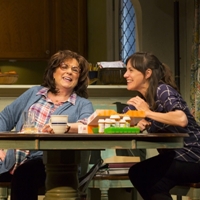
Caroline Aaron & Stephanie Janssen in All the Days (photo: T. Charles Erickson)

At McCarter Theatre in Princeton through May 29, is the world premiere of Sharyn Rothstein’s new family “dramedy,” All the Days. Three generations have their issues: divorced parents in their sixties, uptight divorced daughter, and a grandson approaching his bar mitzvah. The central conflict, though, is mother-daughter. Author Rothstein says, “Mothers and daughters, if they can stand it, should see the play together.”

The action begins in the mother’s kitchen as she recuperates from eye surgery, and her daughter convinces her to come to Philadelphia “until the bar mitzvah.” The Philly living room becomes the setting for most of the play’s numerous short scenes in which the characters laugh together, yell at each other, and reveal their secrets and desires.

Caroline Aaron plays mother Ruth Zweigman, overweight and overbearing, afflicted with diabetes and its consequences. To manage her fears and resentments, not to mention her grief over the death of her only son, she lashes out. Early on, I found her constant comebacks and jibes simply unpleasant, but Ruth warms as the play unfolds.

Daughter Miranda (played by Stephanie Janssen) doesn’t have the temperament for the constant sparring with mom and fled Long Island for the city of brotherly love, Philadelphia. A social worker and newly converted Christian, Miranda’s in the business of fixing other people’s problems, and is frustrated by a mother who doesn’t want to be fixed.

Ruth’s ex-husband Delmore, played by Ron Orbach, is trying to rekindle a relationship with his prickly ex-wife, drawing on her nostalgia and, perhaps, thinking ahead to what his “liver disease” will bring. Ruth sets him straight, saying, “You can’t live in the past and the future at the same time.”

Rothstein holds a degree in public health as well as her MFA, and wove into this play significant public health concerns—problems of diabetes, diet, and stress-related illness among them.

It takes an unerring sense of timing to keep a two and a half hour production moving without a single check-your-watch moment, which McCarter Artistic Director Emily Mann accomplishes superbly as director. Mann says, “I laughed out loud as I read [Rothstein’s] fiercely funny characters, exquisitely wrought, struggling with dilemmas at once heartbreaking and hilarious.”

Leslie Ayvazian plays Ruth’s sister Monica, absolutely able to give as good as she gets and a long-time realist where Delmore is concerned. Justin Hagan plays Miranda’s boyfriend Stew only now meeting her parents and soon realizing why he’s been spared heretofore. Yet Stew recognizes the mother’s essential loneliness and suggests she meet a friend of his—an herbalist, whom Ruth styles “a medical man,” who soon evolves into “a doctor, a surgeon.” This friend, Baptiste Wright, played by Raphael Nash Thompson, provides a welcome layer of calm and understanding to Ruth, like a smoothing, soothing layer of butter over the bumpy and fractured muffin underneath. Matthew Kuenne is the bar mitzvah boy.

Production credits to Daniel Ostling (sets), Jess Goldstein (costumes), Jeff Croiter (lighting), and Mark Bennett (music and sound  design).

For tickets, call McCarter Theatre’s box office (609)258-2787  or visit the box office online.

The Winner’s Circle

horse racing

At Belmont, 2013 (photo: Vicki Weisfeld)

Horses, horse people, jockeys, trainers, and touts. Watching the Kentucky Derby—“the most exciting two minutes in sports”—last Saturday made me think of some of the great books about horses and the quirky, obsessive people who surround them.

The horses are huge, but run on the most fragile of ankles. The jockeys are small, but mostly heart. Racing is a quick way to burn money. No wonder storytellers have capitalized on its dramatic potential.

Horse Heaven – by Jane Smiley. Smiley won the Pulitzer Prize in 1992 for A Thousand Acres, yet I found this novel way more satisfying. She’s developed a stableful of engaging characters as you follow the fates of several horses bred for racing, a risky proposition in the best of times. As much about people and their passions and predilections as about horses, of course.

Lords of Misrule – by Jaimy Gordon. Winner of the 2010 National Book Award, this novel is set in the lower echelons of horse-racing, among people for whom the twin spires of Churchill Downs are a distant dream. She has an almost miraculous way of capturing the way horse people think and talk.

The Horse God Built – by Lawrence Scanlan. This one I haven’t read, but it was too tempting to include a book about Secretariat—“the horse God built.” Secretariat won racing’s Triple Crown (the Kentucky Derby, the Preakness, and the Belmont Stakes) in 1973, with track-blistering performances. This nonfiction book is Secretariat as seen through the eyes of his groom and a story of friendship. This is one of six great nonfiction books about racing compiled by Amy Sachs for BookBub.

Seabiscuit, by Laura Hillenbrand, was made into an Academy Award-nominated film starring Toby Maguire, Jeff Bridges, Chris Cooper, and real-life jockey Gary Stevens. A heartwarming story, this production includes footage shot from the midst of a race—an unforgettable view of why this sport is so dangerous. Rotten Tomatoes critics rating 77%, audiences 76%.

Luck – HBO. For the full immersion experience, try this nine-episode series, developed by David Milch. It’s all-star cast includes Dustin Hoffman, Dennis Farina, John Ortiz, Richard Kind, Nick Nolte, Michael Gambon and, again, jockey Gary Stevens (who raced in the 2016 Kentucky Derby at age 53). The three touts, convinced they’re on track for riches, are priceless. Rotten Tomatoes critics rating 87%; audiences 78%

Sing Street

Sing Street

Ferdia Walsh-Peelo & Lucy Boynton in Sing Street

A charming movie from Ireland about a half-dozen Dublin boys at the Synge Street Christian Brothers School who start a band (trailer). We sort of know this story. We’ve sort of seen it before. But the freshness of the acting make it fun all over again. Conor Lalor (brilliantly played by Ferdia Walsh-Peelo) is a new student at the school and the adolescent boys there plan to make his life miserable. Life at home is bad, too, with his parents fighting and splitting.

A real place, the Synge Street CBS has a long history, and this movie takes place in a time of pupil loss and relatively low achievement (a line in the credits mentions that the school is “not the same place” it was in the 1980s, when the film is set). The first scene of Conor in his new classroom shows the elderly priest who is their teacher, hearing aid dangling, writing on the blackboard with his back to the pupils who are creating holy hell. The principal steps inside and the students stand to attention. The principal glances at the board and points out to the teacher that in this class he is to teach French, not Latin. Teacher: “French. How modern.”

The school’s Latin motto “Viriliter Age” (“Act Manly”), is translated by Conor’s older brother as “Rape your students.” In short, the school is chaos. Conor channels his creativity toward writing songs and creating the band, Sing Street.

These musical ambitions have a lofty goal: impressing the older teen girl, Raphina, who stands near the school every day and claims to be a model. If she is a model, and if he has a band, she can star in his music videos! Simple. The fact that he mostly carries it off is wondrous, resulting in a feel-good movie about a collection of near-misfits who make music work for them.

The band’s songs are by Gary Clark, lead of the 1980s British band Danny Wilson, and it’s good. We don’t know how Conor hears it, but what he sees in terms of music video potential is the pole star he’s determined to follow—and take Raphina with him.

Rotten Tomatoes critics rating, 97%; audiences, 96%.

Broadchurch

David Tennant, Olivia Colman, Broadchurch

David Tennant & Olivia Colman

The engaging ITV crime drama Broadchurch (trailer) (available on Netflix) has run for two eight-episode seasons, released in 2013 and 2015, with a third season filming this summer for release in 2017. It follows the investigation of the mysterious death of an 11-year-old boy in his small seaside town. Soon all the residents are looking differently at people they’ve known for decades. Secrets emerge; journalists are sleazy; people want revenge; and the coppers make mistakes.

The action in Broadchurch takes place in Dorset, in Southwest England, and the investigation is led by police detectives Alec Hardy (played by David Tennant) and Ellie Miller (Olivia Colman). Colman is all over screens big and small this year (The Night Manager, The Lobster). A prize to you if you can catch everything Tennant says, between his character’s thick accent and habit of swallowing his words.

A Cast That Really Supports

All the acting is first-rate, especially that of the detectives and the dead boy’s parents, played by Jodie Whittaker and Andrew Buchan. The story keeps you guessing as to the culprit, revealed at the end of season one. Season two is the trial and introduces some additional fine acting, notably Marianne Jean-Baptiste as the defense attorney. You may remember her as Viv in the U.S. tv series, Without a Trace. She has a severe new hairstyle that gives her a different look, but the voice is unmistakable. Also in season two is Charlotte Rampling as the prosecuting attorney and James D’Arcy as a possible badguy in a previous case that haunts DI Hardy. I remember him fondly as 1st Lt. Tom Pullings in Master and Commander, way back in 2003.

Special mention should be made of the haunting Broadchurch music from Ólafur Arnalds (soundclip), an Icelandic composer and musician, which adds immeasurably to the atmosphere.

U.S. Version Fails

Fox TV created a U.S. version of the series, set in the Pacific Northwest, in a similar seaside town. Called Gracepoint, the series’s most interesting aspect is that David Tennant crossed the Atlantic and the North American continent to reprise his role as the lead detective. In this version he is called Det. Emmett Carver. I wasted no time finding a clip from the show to hear him speak American. He inhabits the other role so completely, the effect was startling! Nick Nolte also appears, as does Michael Peña (The Martian). Alas, the Fox version didn’t measure up and was cancelled after one season of low ratings.

Awards

Broadchurch won many accolades from critics as well as a number of awards. In series one, Olivia Colman won a Best Actress award from the British Academy of Film & Television Arts (BAFTA) and the program received seven BAFTA nominations altogether, including one for Best Original Television Music.

Broadchurch enjoyed a huge audience in the U.K., but not in the United States when it played on BBC America or via streaming. Chances are then that you haven’t seen it, and if you like a compelling crime drama (minus Hollywood’s excessive gore), you might enjoy it!

Awaiting series 3.

The Year’s Best Crime Fiction: 2016

police car

photo: P.V.O.A., creative commons license

Why deal with poorly executed [!], formulaic, airport quality crime fiction, when there’s Best Crime? Booklist’s longtime crime fiction reviewer Bill Ott has combed reviews of the amazing spectrum of books in this genre—from “crime caper novels, psychological thrillers, and history-mystery blends,” to police procedurals, and every kind of crime, white collar to noir, to come up with his top 10 crime novels of the year, 5/1/15-4/15/16.

An end-of-year summary of Best Crime/Mystery/Thriller fiction of 2016, is here.

And, the 2017 update of Ott’s list is here.

Every time the award-granting groups publish their nominees for the year’s top books in this genre, I’ve usually not read (and often not even heard of) any of them. This, despite reading some 70 books a year, heavily weighted toward the new and the criminal.

Booklist’s Top Picks

Mexico, drug cartels

(graphic by Christopher Dombres, creative commons license)

I was delighted, therefore, to see at the very top of Booklist’s review two novels I not only read and reviewed, but found absolutely spectacular—Don Winslow’s The Cartel, a cri de coeur for greater understanding of the clueless U.S. War on Drugs, its spectacular failures, and its deadly impact on the people of Mexico.

The other is Bill Beverly’s Dodgers, a terrific debut novel about a young black man growing up in Los Angeles, how race and crime affect his worldview, and so much more. While I’m not usually a fan of coming-of-age novels, this one will knock your socks off. Says Ott, Beverly’s characters “all live, breathe, and bleed.”

These two books are beautifully written, with convincing characters and engaging plots, and I wish that all the thrillers I read had the same moral significance. The other eight on Ott’s list—which I now want to read to see whether they meet the standard set by Winslow and Beverly—are:

  • Forty Thieves, by Thomas Perry—says Ott, “irresistible” comic capering
  • House of the Rising Sun, by James Lee Burke—“a quest of Arthurian proportions” and, since it’s based in Texas, a must-read for me—hey, those are my kinfolk
  • Is Fat Bob Dead Yet?, by Stephen Dobyns – uproarious, says Ott, who invokes my favorites Elmore Leonard (in his comic vein) and Donald E. Westlake; “loosen the reins of realism,” he advises
  • Jane Steele by Lyndsay Faye – “Reader, I murdered him.” Jane Eyre devotees need know no more
  • King Maybe, by Timothy Hallinan – “one of the best in a sinfully entertaining series” involving crooks in LA, their perfect setting
  • Little Pretty Things, by Lori Rader-Day – A Mary Higgins Clark award-winner, atmospheric and suspenseful
  • The Passenger, by Lisa Lutz – a dark psychological thriller about a woman fleeing the consequences of her husband’s death (What, no sticking around for the insurance?)
  • The Whispering City, by Sara Moliner – an evocative historical, set in Barcelona in the early 1950’s, where General Franco’s security police are everywhere and a newspaper reporter is investigating a death best left alone.

Edgar Winners 2016

While I’m at it, I’ll mention that the Mystery Writers of American recently announced its 2016 Edgar winners. None of the nominees for “best novel” were in the list above, with the winner Let Me Die in His Footsteps by Lori Roy (“a hybrid of mystery, coming-of-age and Southern gothic,” says the LA Times). MWA’s award for “best first novel” went to Viet Thanh Nguyen’s The Sympathizer (a cerebral spy thriller about the Vietnam War and winner of the Pulitzer Prize).

Be sure to check out the “Reading . . .” tab above to find more book reviews, many in the crime/mystery/thriller genre.