At Least Someone’s Paying Attention

texting while driving

(photo: activerain.trulia.com)

Video about texting and driving grabs teens’ attention (link below). In the last weeks I’ve been driving the Interstates and major highways in three northeastern states and one Canadian province. From this limited cruise, only New York State showed evidence it is tackling the dangerous practice of texting while driving. We’re all familiar with the roadside “rest stops”; now NYS has added “text stops,” announced with frequent signs like “It can wait: Text stop 5 miles.” These areas are pretty close together, too, at least on Interstate 81. In some places, they’ve added “text stop” signage above existing rest stop signs, but in others, they’ve created a quarter-mile lane for cars or trucks to pull off the highway, send that vital text message, and pull back on. For what can happen when you don’t, see this absolutely brilliant video.

Truthfully, I didn’t see very many people pulled over to text, but planting the seed that there’s a time and place for texting is a worthy effort that may have a long-term impact. Better that than the kind of impact pictured above.

Nordic Noir – Scandinavian Crime Fiction

clouds, sky

(photo: wikimedia.org)

Readers and fans of modern crime novels have been aware of the Scandinavian writers’ mafia for some time—long before The Girl Who/With . . . trilogy commandeered airport book stalls. Stieg Larsson was, in fact, only one of the hundred or so crime authors from Norway, Sweden, and Denmark whose books have been translated into English. “The crime tale has become to Scandinavia what the sonnet was to Elizabethan England: its trademark literary form,” says Lee Siegel in “Pure Evil,” a recent New Yorker essay on the rise of Scandinavian crime fiction.

An early signal of the impending invasion may have been the unexpected success of Smilla’s Sense of Snow, by Danish author Peter Hoeg (1992), a book I enjoyed greatly. As did a friend of mine’s mother, luckily only slightly injured when a tractor-trailer jackknifed in front of her on the New Jersey Turnpike and her car slid underneath. As the EMT’s loaded her into the ambulance, she yelled, “My book! Get my book! It’s on the front seat of the car.” Smilla’s Sense of Snow.

A line from Swedish crimewriter Henning Mankell—“every good story has a mystery in it” titles the home page of this website. He’s familiar to American readers and PBS Mystery! watchers for his Inspector Kurt Wallander mysteries. Several of these novels have been dramatized starring Kenneth Branaugh of the tiny mouth and co-starring the unutterably grey-and-gloomy Swedish skies.

From what source did all this high Nordic gloom arise? Siegel’s essay, which features Norway’s popular author Jo Nesbø cites several causes, perhaps most significantly the unsolved 1986 assassination of Swedish Prime Minister Olof Palme, shot in the back while walking home from a movie theater. “The paranoia engendered by Palme’s killing,” Siegel says, “endowed the Scandinavian crime novel with a horrifying vitality.”

Also, in Norway—the territory of Nesbø’s Inspector Harry Hole novels—the discovery of oil led to a newly privileged class, and the social fears and resentments that ensued became fodder for the crime novelist, Siegel says. You will recall how in 2011, those class differences erupted in real life, when Anders Behring Breivik with bombs and guns killed 77 people, “most of them the young sons and daughters of the country’s liberal political élite” murdered at an island-based Workers’ Youth League camp.

Harry Hole of the Oslo Police Department is the protagonist in ten of Nesbø’s books—works that “stand out for their blackness.” Nesbø himself, on the interesting author-interview website Five Books (which also has interviews about Swedish and Nordic crime fiction), talks about how the mentality of the criminal is “actually very similar to the mentality of the police. And that is true for the main character in my books, Harry Hole. He experiences the same. The people he feels he can most relate to are the criminals that he is hunting.”

Nesbø’s books have sold 23 million copies in 40 languages, and several are on their way to being made into movies, suggesting that social fears and resentments are not themes confined to a single geographic locale, even if they can be presented in bleaker aspect against a lowering sky.

Read more:

Scandinavian Crime Fiction – billed as “your literary portal into Northern deviance,” featuring numerous authors, downloadable books (audio and e), and other resources

A Cold Night’s Death: The Allure of Scandinavian Crime Fiction – a guide from the New York Public Library

No. 1 With an Umlaut – Boris Kachka in New York magazine includes Iceland and Finland in his guide to this “massive iceberg of a genre.”

Enhanced by Zemanta

Plastic Guns

meteor

(photo: c1.staticflickr.com)

In the hands of a good mystery/thriller writer, the presence of undetectable plastic guns can change the dramatic equation. But in case the real-life possibility of seriously lethal 3-D printed guns existing outside the weakly regulated firearms marketplace has been a problem barely on the edge of your consciousness, a threat like a massive meteor strike—remote, but awful—it’s time to give it further thought. A Wired article by Andy Greenberg, full of anonymous sources and YouTube videos of test-firings, shows how far this technology has come. Predictably, the cost of manufacture has plummeted as lethality has risen.

A combination of libertarians, gunsmiths, and technology enthusiasts has been improving on printable handgun and rifle designs, step-by-step, moving “3-D printed firearms from the realm of science fiction to practical weapons.” And, Greenberg says, leaving “legislators and regulators in the dust,” despite the Undetectable Firearms Act. Another reason this situation is like a meteor strike is, given what we know—in this case about human behavior—these developments seem unstoppable.

The RFID article below suggests how a different technology can contribute to gun safety, too, for conventional handguns.

***Ellery Queen Mystery Magazine

Just finished the May, June, and July 2014 (how do they assign the date to this publication?) issues of EQMM. As always, a real mix of styles, eras, and plotting in the 28 stories therein, by both new and established mystery writers. Among the stories I liked best were those by:

homeless, dog

(photo: shiftfrequency.com)

  • Frankie Y. Bailey really got my curiosity going. She has a new book out, The Red Queen Dies
  • Alex Grecian – in whose story, a woman’s wireless pacemaker is threatened by a mysterious caller. Grecian, author of the NYT bestselling historical mystery The Yard, might have read the April 30 story on this website!
  • Brian Tobin’s “Teddy,” about a homeless man’s love for his dog, was powerful writing. Tobin’s two novels, The Ransom and A Victimless Crime, have been well-received.
  • I’ve grown to like the EQMM stories by Dave Zeltserman—two of whose mystery tales, A Killer’s Essence and Outsourced, are being optioned for film—which put a 21st century twist on the Archie-Nero Wolfe relationship. In Zeltserman’s version, “archie” is a “two-inch rectangular piece of advanced computer technology” that his owner, Julius, wears as a tie-pin. While Julius talks, Archie researches. Cute.
  • Liza Cody has created an engaging, not-so-sure of herself police constable Shareen Manasseh to good effect, and another story with Manasseh appears in the British Crime Writers’ Association’s new collection, Deadly Pleasures, and many novels, most recently, the Dickensian Lady Bag.

Eastern State Penitentiary

Eastern State Penitentiary, prison, isolation

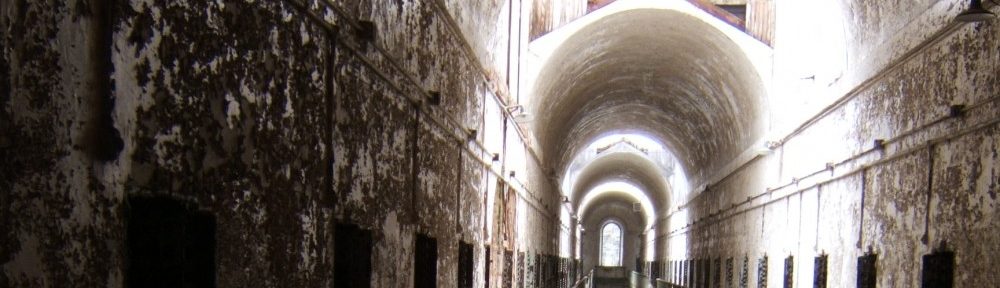
Eastern State Penitentiary, Philadelphia (photo: author)

Many East Coasters recognize the photo featured on this website home page as taken inside the crenelated walls of Eastern State Penitentiary. A “model” institution when it was built outside Philadelphia in the early 1820’s, Eastern Pen remained in use until 1970, by which time officials deemed it “not fit for human habitation.” Governing magazine’s David Kidd recently created a photo essay about this crumbling institution, now near the city’s downtown.

Although the felons have left, today Eastern Pen is a tourist attraction and hosts concerts and other events. If you visited it today, May 10, you could attend a reunion of inmates and guards, who would answer your questions about their former lives there. Every fall, it hosts Terror Behind the Walls, “a massive haunted house in a real prison.”

Kidd points out that the Quakers who built Eastern Pen originally constructed only single-person cells, so that miscreants would have absolute solitude to reflect on their crimes and on the Bible. This, the founders believed, would make men truly penitent (“penitentiary”). In this original sense, a penitentiary differed from a prison, where convicts mingled and shared cells. From the time a prisoner entered Eastern Pen and was led to his cell (wearing a hood) until the time he left (also hooded), he never saw or spoke to another human being. Later, with more crowding, that changed.

The city fathers were proud of their innovation and eagerly showed it to visitors, one of whom was Charles Dickens. Dickens was horrified at the suffering he believed this total isolation would produce. He was inspired to replicate it in A Tale of Two Cities, where the solitary cell in the Bastille drove his character, Dr. Manette, insane.


Enhanced by Zemanta

Hackers in the Hospital

Innocent-looking bedside computer!(photo: c1.staticflickr.com)

Innocent-looking bedside computer!(photo: c1.staticflickr.com)

Seven years after the Vice President Dick Cheney’s cardiac defibrillator was disconnected from the net to protect him from a wireless attack, hospitals have done little-to-nothing about the security problems in a myriad of medical equipment and devices, according to a recent Wired article by Kim Zetter. Worse, they seem unaware of the risks.

The defibrillator problem resurfaced in a 2012 episode of Homeland, but the thriller-writing community has yet to explore the full horror of this catastrophe in waiting. The problem? All the old familiars: hard-coded passwords, simple easily-guessed passwords, problem notification features that can be turned off, and lack of authentication systems. With equipment networked to provide medical records with test and x-ray results, placing false information in the record is comparatively easy. Even if equipment and devices aren’t themselves connected to the internet, the easily hacked internal systems they are connected to may be externally accessible—and certainly internally accessible if one employee responds to a phishing attack.

Additional examples of potentially lethal equipment hacks include: changes to morphine or other drug dosages delivered to patients via drug infusion pumps; adjustments to temperature settings on refrigerators that store blood and drugs; and alterations in electronic medical records.

It might be difficult to target specific patients with such rogue equipment and documentation changes, at present, but “random attacks causing collateral damage would be fairly easy to pull off,” the article reports. Some devices, unique to an individual, such as the implantable defibrillators, are targetable now.

Medical thrillers using these vulnerabilities as plot devices might do an inadvertent public service by sensitizing hospitals and the public to the risks.

Enhanced by Zemanta

***** An Officer and a Spy

Emile Zola, DreyfusBy Robert Harris (read by David Rintoul) –This novelization of the infamous Dreyfus affair in turn-of-the-20th Century Paris starts slowly, then builds powerfully. French Army Officer Alfred Dreyfus, a Jew, was sentenced to life imprisonment on aptly named Devil’s Island on flimsy and trumped-up evidence that he was a spy. As the book’s narrator, Lt. Col. Georges Picquart, gradually discovers, a spy remains in the French military command and, if so, he begins to suspect and then believe that Dreyfus is innocent.

As in the present day, it isn’t so much the original crime—in this case, convicting an innocent man—that creates all the problems, it’s the cover-up. The book is full of real-life characters of the time with whom I was passingly familiar—Georges Clemenceau, Émile Zola (J’Accuse!), Picquart, who rose to be Minister of War after Dreyfus’s release, and of course, Dreyfus. Learning how they out-maneuvered the army’s top generals is riveting, even though you know they ultimately succeed. Alphonse Bertillon, the originator of concepts of scientific policing reappears, with some dubious handwriting analyses; his contributions were explored more fully in The Crimes of Paris, which I read last year.

Louis Begley’s New York Times review would have had the book provide more context about French society at the time, though some of his examples are to me pretty clear: the high position of the army in society and “the extraordinary wave of virulent anti-Semitism that had washed over France since the 1880s.”

The Dreyfus case still resonates today, not least because of the resurgence of anti-Semitism in Europe from both the left and right wings and the growing Muslim communities. Coincidentally last weekend, I attended a reading and discussion of a new play by McCarter Theatre’s Emily Mann, Hoodwinked, about the shootings at Ft. Hood and the friction between tolerance and intolerance within radical Islam and outside it. Looking back on Dreyfus, it’s easy to see where the players went wrong out of prejudice, self-interest, and absolutism. We see events in our own time through these same distorting lenses and, therefore, unclearly.

Best Mysteries and Thrillers

book cover

(photo: catalog.lambertvillelibrary.org)

How many of the “best” in mysteries and thrillers have you read? I’ve read about 30 of the Amazon 100 best list, though if I could count the movie versions the number would rise to about 42. No double-counting for both reading From Russia with Love and falling for Sean Connery. Especially note how the cover for Mary Roberts Rinehart’s The Circular Staircase could be mistaken for a “Carolyn Keene,” represented in the Amazon list by The Secret of the Old Clock, my very first Nancy Drew.

The compilers seemed to go for the first in a series, like the first Jason Bourne or the first Inspector Gamache, perhaps thinking that a strong beginning will lead people to subsequent books in the series.

We’ve read the statistics about how Americans are reading fewer books. But they still love mysteries and thrillers. Some people are drawn to reading because they can identify with the characters and others because of “that excitement of trying to discover that unknown world,” said author Azar Nafisi. That might be a foreign country, a foreign planet, a foreign psyche. Mystery and thriller readers get both. A protagonist they can identify with and a journey through that foreign world (of crime, of spies).

Enhanced by Zemanta

**** The Reversal

Michael Connelly, Mickey Haller, Lincoln Lawyer

If you’ve read the Lincoln Lawyer series, you know Mickey Haller does most of his legal work from the back seat of his Lincoln Town Car, which has the vanity plate NT GLTY

Got my Michael Connelly fix for the year—The Reversal—a 2010 crime thriller that alternates chapters between brash lawyer Mickey Haller and his half-brother (or did you miss that one?) cynical LAPD detective Harry Bosch. Both men have teen daughters so are especially anxiety-prone when a man convicted of abducting and murdering a young girl is released from San Quentin as a result of DNA evidence and must face trial again after 24 years.

It’s interesting how Haller—working for the prosecution this time—must introduce old evidence without revealing to the jury the prejudicial information that the accused has already been convicted once. Nor can he say why some witnesses are unable to appear (dead or demented) and interviews with them, actually their previous trial testimony, must be read aloud.

While this isn’t Connelly’s best, he never disappoints and received four Amazon stars from readers. If you like every plot angle tied up with a bow, in this one, that doesn’t happen, and the author leaves Harry still pursuing leads as to the convict’s possible involvement in other crimes. It’s as if Connelly was leaving the door open for a never-written sequel.

Matthew McConaughey, Lincoln Lawyer

Matthew McConaughey stars in the movie version – note vanity plate!

For a fun Netflix pick, Matthew McConaghey in The Lincoln Lawyer. Rotten Tomatoes Critics rating: 83%. I thought it was better than that, and I’d read the book! Also notice how the movie poster changed the license plate to “NT GUILTY,” thinking viewers were too dim to figure it out, I suppose.

Enhanced by Zemanta

**** Midnight in the Garden of Good and Evil

Midnight in the Garden of Good and Evil, John Berendt, Savannah, Georgia

Savannah (photo: wikimedia.org)

As it seems I’m one of the last people in America to read Midnight in the Garden of Good and Evil, John Berendt’s 20-year-old best-seller, I’d heard enough sly references and snippets—especially when the movie (trailer) came out–to have a pretty good idea of what I’d encounter in its Historic District (free map!). I was not disappointed. While many people gravitated to the over-the-top drag queen, The Lady Chablis, my favorite character was Minerva, the purple-glasses wearing juju expert. Berendt allows that, although his book is nonfiction, he did mess with the time sequence a bit and disguise a few characters who needed a veil of privacy. Savannahians surely know when and who.

I hadn’t realized Savannah was so geographically and topographically isolated and that its residents used that isolation to their advantage, wanting “nothing so much as to be left alone,” Berendt says. “Every nuance and quirk of personality achieved greater brilliance in that lush enclosure than would have been possible anywhere else in the world.” It’s sadly ironic, then, that his book has inspired so many tourists and Midnight-themed tours.

And the perfect, related cocktail?