
“He’s Got a Gun!”

gun, firearm, weapon

(photo: r. nial bradshaw, creative commons license)

The late Elmore Leonard advised budding crime-writers, “when your story starts to drag, have someone pull out a gun.” Maybe too many of us have been following that advice, because several recent books aim to inject more accuracy into the portrayal of guns (and other weaponry). Errors make some readers swear off a writer and, as the introduction to The Writer’s Guide to Weapons: A Practical Reference for Using Firearms and Knives in Fiction
explains, “no wrath is greater than that of firearms enthusiasts.”

According to a recent post in Jane Friedman’s excellent “Resources for Writers” blog, written by Benjamin Sobieck, who also wrote the Writer’s Guide, above, here are key points about guns that writers should keep in mind to avoid those credibility-shattering results:

  1. Clip and magazine are not the same. A clip holds cartridges that go into a magazine. Most modern firearms don’t require a clip. But it sounds good, no? Clip: Manly. Magazine: Better Homes & Gardens
  2. Bullet is not the same as shell, round, or cartridge. You never find empty bullets on the ground after a shooting. Casings, yes.
  3. The whole pumping of a shotgun or cocking the hammer of a handgun is a sound cue from the movies, intended for intimidation, but, as Sobieck says, “less to do with looking tough and more to do with being stupid.” These extra and in most cases unnecessary pumps/cocks just “dump unfired ammunition onto the ground.” Why would anyone intimidate another person with a firearm, if it weren’t ready to fire? Good question. Ask your author.
  4. While this would seem to be an “it goes without saying” kind of thing, a character should never look down the barrel of a gun to see whether it’s loaded. Who’d be that stupid? I had a clip showing a tv character actually doing this, but it has disappeared. Sorry!
  5. And, perhaps the most pervasive of all gun errors in both news and entertainment media currently, the term “assault weapon.” This actually is meaningless. ANY weapon can be used for assault. The industry doesn’t use it. Sobieck says “tactical rifle (or shotgun), machine gun, submachine gun, fully automatic rifle,” or even “gun” are more meaningful than “assault weapon.”
  6. The term “automatic weapon” is often elided to mean either a semi-automatic weapon (which shoots one time with each trigger pull) or a “fully automatic weapon” which fires many times with a single pull. The idea of “automatic” weapons needs to be well defined. Fully automatic weapons are not very accurate after the first few shots because of recoil, so long, Rambo-inspired bursts of fire are actually useless if the goal is to hit anything.

Finally, in his book, Sobieck includes “Ten Golden Tips for Writing about Weapons,” which includes this advice: “If it’s in a movie or on television, it’s probably inaccurate.”

***The Storm Murders

farm, snow, winter

(photo: M Pincus, creative commons license)

By John Farrow – Farrow is the pen name that acclaimed Canadian writer Trevor Ferguson selected when he decided to try his hand at writing genre fiction, and, if I have this right, this is his fourth book featuring detective Émile Cinq-Mars and the first of a planned “storm murders” trilogy.

In this mystery/thriller, prickly retired Montreal Sergeant-Detective Cinq-Mars finds himself flattered and cajoled and inevitably drawn into helping in the investigation of a rural Quebec double-murder that culminated in the additional slaying of two young Sûreté du Québec police officers lured to the remote farmhouse by a phone call.

Perhaps Cinq-Mars decides to aid this investigation because he is intrigued by the crime itself, the lack of apparent motive, and the absence of the killer’s footprints in the newly fallen snow around the house. Perhaps it is the puzzling entreaties of a senior FBI agent, looking for answers in a case that’s way out of his jurisdiction. Perhaps it is the bleak persistence of a Canadian winter making the days weigh heavy on Cinq-Mars’s insufficiently occupied brain. Or perhaps it is his wife Sandra’s startling intimation that she might leave him, making the investigation a welcome preoccupation that might enable him to in some way resurrect the man she’d fallen in love with.

The FBI agent, frustratingly close-mouthed, at least reveals that the deaths of the Quebec couple share certain grisly similarities with a series of murders in the United States. All have involved a married couple, always they’ve occurred after a major calamity. As none of the neighbors know much about the couple, relatively new arrivals to the area, and in the hope of finding out more details that would suggest a connection among these deaths, Cinq-Mars travels to New Orleans. The first pair of murders occurred there, shortly after Hurricane Katrina. Sandra accompanies him, because the trip promises to be a semi-vacation. Both she and Cinq-Mars hope a change of marital venue will help them reconnect.

Booklist has called the Cinq-Mars books “the best series in crime fiction today,” and this is the first of them I’ve read. Farrow’s writing style, honed by writing literary fiction, is confident and sophisticated, and the book starts strong. In general, the characters and setting are interesting and well-developed, especially good-humored multi-racial NOPD detective Pascal Dupree and ambitious hotel security chief Everardo Flores, who enliven every scene they’re in. Unfortunately, the plot was not as robust as these other elements. I guessed early on (and I’m not a particularly insightful guesser) why the FBI was interested in this series of murders. Farrow receives praise from some reviewers for writing character-driven mysteries, but for my taste, Cinq-Mars’s examinations of his feelings about religion, his wife, and retirement are rather too long. The denouement also was drawn out past the point of believability, including both conversation and events that seemed unlikely.

While this book has much to recommend it, especially for admirers of the series, in the end it requires some suspension of disbelief.

A slightly longer version of this review appears—along with reviews of many new crime and thriller novels—at the Crime Fiction Lover website.

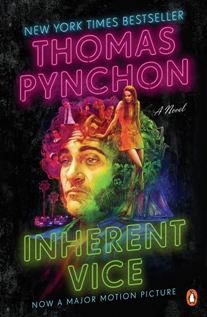
Inherent Vice

Inherent Vice, Joaquin Phoenix, Thomas PynchonWhen this film (trailer) of a Thomas Pynchon novel was released in 2014, critics said it was undoubtedly the ONLY Pynchon book that could be corralled into a film. I’m a big Pychon fan—loved V, The Crying of Lot 49, and Mason & Dixon—but I started Gravity’s Rainbow three times and never got past page 100. So I can sympathize with the difficulties director Paul Thomas Anderson must have faced.

Joaquin Phoenix plays “Doc” Sportell, a private investigator subject to regular harassment from a police detective called Bigfoot (Josh Brolin). Doc’s ex-girlfriend Shasta has taken up with a wealthy married property developer, and the developer’s wife wants her to cooperate in a plot to institutionalize him so she and her new boyfriend can raid his bank account. Then the magnate disappears. Doc uses is slight investigative skills to search for both the developer and Shasta in a stoner’s 1970s Southern California.

This set-up takes you down colorful and unexpected byways, which I couldn’t possibly reconstruct, and a multitude of stars provide performance gems: Owen Wilson as a mixed up dude-dad, afraid to leave the drug cult that’s captured him; Hong Chau as the hilariously matter-of-fact operator of a kinky sex club; Martin Short as a cradle-robbing dentist, with his clinic in a building shaped like a golden fang; Golden Fang itself, a mysterious criminal operation that . . . None of this probably matters. Neo-Nazi biker gangs, yogic meditation, stoners. You just have to go with it. Joaquin Phoenix, understandably, displays about a zillion different ways of looking confused.

If you have a taste for the absurd and what Movie Talk’s Jason Best calls “freewheeling spirit,” this is definitely the movie for you! I try to guess whether audiences or critics will like a movie better. Right on the money this time: Rotten Tomatoes Critics Rating: 73%; audiences, 53%.

***Ellery Queen – February to May 2015

Sherlock Holmes, detective

(photo: wikimedia)

The short stories in the Ellery Queen Mystery Magazine sometimes lead me to authors whose books I also enjoy. Here are several of the stories I especially liked from the February, March/April, and May 2015 issues:

  • Terence Faherty’s “The Man with the Twisted Lip”—a Sherlock Holmes parody—very entertaining. Faherty is an award-winning mystery writer with two long-running series. His most recent stand-alone novel, The Quiet Woman, set in Ireland, was published last year. [February issue]
  • “Leap of Faith” by Brendan DuBois about the lengths a boy will go to in order to protect his sister. DuBois’s most recent book is Fatal Harbor (2014) features his “fascinating character” (Boston Globe), former Defense Department analyst Lewis Cole.[February issue]
  • Loren D. Estleman’s story, “The Black Spot,” has hitman Peter Macklin doing clean-up for a Detroit-area mafia chieftain. Estleman’s 2014 book Don’t Look for Me is book 23 in a series featuring Detroit private investigator Amos Walker, “who views a dishonest world with a cynical eye—and is still disappointed” (Booklist).[March/April]
  • In “The Lovers of Traber,” private eye Willie Cuesta travels from the Miami he inhabits in Pulitzer-winning journalist John Lantigua’s crime novels to a rural Florida farming area to sort out a romantic interest gone too far afield. His most recent Latin-flavored book is On Hallowed Ground. [March/April]
  • Art Taylor’s first-person story “Commission” is told with a good sense of humor and will appear this fall in his book of short stories, On the Road with Del and Louise. [May]
  • “A Loneliness to the Thought,” by Michael Caleb Tasker, is set in New Orleans, with a teenage narrator whose life has that amber-enclosed feel of adolescence, while a series of murders takes place in the city. Nice evocation of place. Watch for his short stories. [May]

Always an entertaining read and available digitally from Amazon, B&N, Google Play, Kobo, Apple iPad, and Magzter.

****Gun Street Girl

Ireland, street scene, Belfast

Belfast street (photo: Recuerdos de Pandora, Creative Commons license)

By Adrian McKinty, narrated by Gerard Doyle Gun Street Girl takes place in Belfast, in the mid-1980s, and The Troubles provide a fine backdrop of tension and mayhem. It’s the fourth (yes!) of a planned trilogy, because McKinty—and his readers—couldn’t quite let Detective Sean Duffy go.

The complex plot grows out of actual events of the era, including missile thefts from aerospace company Short Brothers (a convoluted affair in real life) and the hostile environment created by the Thatcher-FitzGerald Anglo-Irish agreement. In the novel, Duffy is out of step as usual with his confreres in law enforcement, especially for being the rare Catholic in the Royal Ulster Constabulary. When a murder investigation takes Duffy and a new recruit to Oxford, England, they encounter a more generalized anti-Irish prejudice. The British coppers apparently believe the Irishmen will be satisfied to sit in their cozy b&b in Oxford (unless my ears mistook, referred to as “Morse-land,” in a nice homage) and drink whiskey. They are, of course, mistaken.

What has taken them to Oxford is the unraveling of a case that at first appears open-and-shut. A couple is found murdered, and it looks as if their son shot them then committed suicide. Under Duffy’s supervision, Detective Sergeant McCrabban is technically in charge of this investigation and is ready to close the books on it, but something’s not quite right. For one thing, no one really wants Duffy and McCrabban poking around in it.

Meanwhile, Duffy’s future with the R.U.C. faces an almost-certain dead-end, and MI5 agent Kate tries to recruit him for her agency. All things considered, a change of employer is more than a wee bit tempting. She’s the Gun Street girl, and, as Tom Waits would have it, Duffy will “never kiss a Gun Street girl again.”

Doyle has won numerous Earphones Awards from AudioFile, and has a solid history narrating mysteries and thrillers. In this book, he must present various Irish and English accents and does so beautifully. I could listen to the book again just to hear him read it. Detective Duffy’s voice is crucial, since the story is told in first-person narration, and Doyle captures him—and McKinty’s dry, self-deprecating humor—beautifully.

A longer version of this review is available on the Crime Fiction Lover website.

***The Accidental Pilgrim


Stephen Kitsakos

Author Stephen Kitsakos

By Stephen Kitsakos – Rose Strongin is a woman with a secret so deep even she doesn’t know what it is. Worse, it’s the kind of secret that’s contrary to her way of understanding the world, honed throughout her training and career as a research scientist. This secret involves something that couldn’t possibly happen in real life. Or did it?

In the mid-1970s, early in her career, Rose has the exciting opportunity to travel to Israel with her husband and daughters on a project near where the biblical town of Dalmanoutha is believed to have stood. (In this regard, Kitsakos’s fictional account mirrors real-life archaeological discoveries.) Dalmanoutha is the village on the western shore of the Sea of Galilee where, the Bible has it, Jesus fed the multitudes with a few fishes and loaves of bread. When Rose first meets the magnetic director of the research project, Dr. Noah Chazon, an unexpected chemistry ignites between them.

On the day Rose and her family are to return home to Toronto, Rose disappears. Despite diligent searching by everyone involved in the project, Rose cannot be found for several hours, and the family misses its flight. Unaccountably, Rose says she cannot remember where she was or what she was doing. Her husband Simon, aware of Rose and Chazon’s mutual interest, suspects the worst, and in the ensuing years Chazon’s reappearances are a sore spot in the couple’s marriage.

Still, for Rose, the interlude on the beach remain a blank: “Time had stood still for her and all she could recall was walking down the long slate path . . . as if she had walked into a cloud and come out the other side, three hours later.” In her hand was a mysterious piece of wood.

This vagueness is uncharacteristic of Rose and, in itself, raises questions. But whatever happened, it saves the family, as the flight they would have taken crashes into the sea, and all aboard are lost. Was Rose’s disappearance a form of premonition? Rose is not the only person to have had such an experience in that place. And each such revelation deepens the mystery, as do the shards of Rose’s own experience that come back to her in brief flashes of recognition and understanding many years later.

Much of the novel is told in near-distant flashbacks, but it opens in the current day, in Israel, with Simon, his two daughters, and the son conceived the night the family unexpectedly missed their plane. They are gathered to fulfill Rose’s last wishes, including that her ashes be scattered on the Sea of Galilee at the place where she disappeared thirty years before. Through the memories these actions stir, the reader gains an understanding of Simon and Rose and their marriage, Rose’s relationship with Noah Chazon, and how three missing hours affected everything that followed. I had the chance to ask Stephen Kitsakos about the novel’s structure, and he said that, although he wrote the book in fragments, eventually, the family’s return trip to Israel with Rose’s ashes became the spine of the story, connecting all the parts and keeping it moving forward.

At its heart, the book contains a number of mysteries that can be interpreted in different ways—metaphorically, literally, or spiritually—which gives the reader much to think about and can make for a lively book group discussion! To me, the strong underlying message is about the enduring power of love, though Kitsakos put this thought much more elegantly in response to my question about message: “The greatest mystery of all is what connects us to our ancestors, ourselves, and each other,” he said.

Kitsakos is a theater writer and journalist and has written the librettos for three operas, including an adaptation of Khaled Hosseini’s A Thousand Splendid Suns. His talent at setting a dramatic scene and creating compelling characters is put to good use in this intriguing novel.
tlc logo

A Cozy Arrangement

Murder, She Read, is a research report from Nielsen Book Research (a copy will set you back $1,500), on the book-buying preferences and habits of some 6000 nationally representative U.S. mystery/crime readers. The researchers defined “mystery/crime” as

a genre of fiction typically focused on the investigation of a crime. Mystery fiction is often used as a synonym for detective fiction or crime fiction—in other words, a novel or short story in which a detective (either professional or amateur) investigates and solves a crime mystery.

This is a more restrictive definition than most, but a lot of books fit it. Highlights of the study results:

  • cat reading

    (photo: raider of gin, creative commons license)

    Most “mystery” readers (70%) are female

  • The biggest age group of mystery readers (28%) comprises people 65 and older, with almost half of mystery readers 55 and older and
  • Many mystery readers are not actually buying their books; they’re getting them free.

The gender and age concentrations revealed come as no surprise. Month after month, I see lists of the mysteries agents and publishers are signing. Their decisions are creating and reinforcing this important audience, and its dominance is an effect of the choices they make.

I certainly don’t want to suggest there shouldn’t be books geared to the older female demographic, but mysteries that involve clever kitties, cutesy shops, knitting patterns, and recipes not only succeed in appealing to one specific group but also fail to develop new communities of interest.

Authors can—and do—write novels that appeal to both men and women. And many women readers devour books by Michael Connelly, Tana French, Ian Rankin, and Laura Lippman just as much as men do. However, a focus on novels with marketing appeal to only one segment of the population (and a low- or non-paying one at that) may prove counterproductive in the long run. I hope authors and publishers read the Nielsen findings as a call to reach out to tomorrow’s audiences—readers who will be as loyal and enthusiastic as the older woman audience is today.

****The Bad News Bible

Jerusalem

(photo: David Holt, Creative Commons license)

By Anna Blundy – Reading and reviewing classics like The Long Goodbye or best-sellers like Mr. Mercedes and trying to develop my own take on them is fun, but even more rewarding is discovering an author whose books have flown under the radar and bringing them to your attention! In that category, here’s The Bad News Bible (2004), published by Felony and Mayhem Press, a murder mystery set in the heart of Jerusalem, with all the dangers and dislocations thereunto. Ask Brian Williams.

Perhaps because in real life her father was a British war correspondent, killed in El Salvador, Blundy made her protagonist a war correspondent, too. Faith Zanetti is ensconced with a profane, chain-smoking, hard-drinking crowd of journalists with whom she’s spent many dusty hours. Though they work in deadly dangerous places and though gallows humor is one way they stay sane, Faith doesn’t expect murder to invade this close circle of colleagues and competitors. Reviewers have said Faith “is a heroine who was waiting to be created,” the one “we’d love to be.” Faith has been carried along by her courage and her cynical sense of humor into four more books after this one, first in the series.

The book’s title is what Faith’s best friend calls the reams of advice the correspondents are given about staying safe in a war zone, information in stark contrast to the ever-present “Good News Bible” in their hotels’ bedside table drawers. Faith has humor, sharp perceptions, and calls them as she sees them, exactly the traits needed to survive—and Get the Story—in her tricky situation. And Blundy’s writing has the energy to carry it off.

(If you order this book, make sure you buy the one by Anna Blundy. Another has the same title but is a different thing altogether!)

****Rage Against the Dying

Route 66, highway, Arizona

(photo: wikimedia.org)

By Becky Masterman, read by Judy Kaye — Delighted to find this first-time mystery-thriller, which appeared on seven “best of” lists for 2013. At first, I thought, “Oh no, not another story about long-haul truckers and their women victims,” but the book soon took a sharp turn away from that tired track, and we discover the would-be victim is a retired FBI agent with certain skills.

The agent is Brigid Quinn, asked informally to help put to rest an old case—the murder of her young trainee by the “Route 66 killer.” A man has confessed to this string of murders and told authorities where to find the agent’s body. But the FBI agent in charge of the case doubts the confession and persuades Quinn to doubt it, too. Meanwhile, the real killer is out there . . . and no one but the two of them appears to care whether he’s caught.

The book uses its Tucson setting to advantage, and Quinn shines hard as a diamond in the unrelenting Arizona light. Her first-person narrative is “chilling, smart, funny, and what a voice she has,” said Gillian Flynn, author of Gone Girl. The narration was perfect. Cheers to both Masterman and Kaye. Looking forward to reading the second book in the series, out now!

****The Long Goodbye

$5000 bill

“The Madison” (photo: wikimedia.org)

By Raymond Chandler – This hardboiled detective story from 1953 is one of Chandler’s last featuring detective Philip Marlowe, and all the usual appeal is here—Los Angeles riffraff, a complex plot, and the sly, ironic first-person tone of wiseass Marlowe, who narrates. Although the prose conjures the voice of the ultimate Marlowe interpreter, Humphrey Bogart, the movie version was on ice for two decades, awaiting the deft touch of Robert Altman, with Elliott Gould as Marlowe. (FYI, the Rotten Tomatoes critics give this one a 96% rating, so it’s now on my Netflix list!)

Lots of alcohol gets sloshed in this story, written at a period when Chandler—an alcoholic himself—was at a serious low point (his wife was dying) and discouraged about his writing. It was late in his career, and he wanted to be taken more seriously. A few plot elements don’t quite hang together, and “the Madison” (a $5000 bill a client sent him) is not the unbelievable windfall it was in 1950, yet the writing propels you forward from sentence one: “The first time I laid eyes on Terry Lennox he was drunk in a Rolls-Royce Silver Wraith outside the terrace of The Dancers.”

Keep reading, and you’re rewarded with thrilling descriptions (“His eyebrows waved gently, like the antennae of some suspicious insect.” “On the window sill a bee with tattered wings was crawling along the woodwork, buzzing in a tired remote sort of way, as if she knew it wasn’t any use, she was finished, she had flown too many missions and would never get back to the hive again.” A metaphor that probably says as much about how Chandler—and Marlowe—were feeling at that moment as it does about how the fictional bee may have felt.) Of course, Chandler was equally observant and precise in his descriptions of people: “There was the usual light scattering of compulsive drinkers getting tuned up at the bar . . ., the kind that reach very slowly for the first one and watch their hands so they won’t knock anything over.” Oh yeah.

In a crime fiction anthology published in 1995, mystery writer Bill Pronzini called The Long Goodbye “a serious and significant mainstream novel that just happened to possess elements of mystery.” Contemporary novelist Paul Auster wrote, “Raymond Chandler invented a new way of talking about America, and America has never looked the same to us since.” A pity Chandler didn’t anticipate that the critics’ unwavering praise of him ultimately would extend beyond genre borders.

If the books leave you wanting more, take the awesome Esotouric Raymond Chandler Tour or get the map of his Los Angeles settings, described in this popular post from last fall.