Bill Scheide’s Extraordinary Gift

Gutenberg Bible

The 1455 Gutenberg Bible (photo: Natasha D’Schommer, courtesy of Princeton University)

When Princeton, N.J., philanthropist Bill Scheide (SHY-dee) died last year at age 100, he left his alma mater (Princeton ’36) a gift that would make any lover of books and music brim with joy. His collection of approximately 2,500 rare printed books and manuscripts, when it is appraised, is expected to be worth nearly $300 million, making it the largest gift in the University’s history.

Scheide majored in history at Princeton and earned his master’s degree in music at Columbia University in 1940. His father and grandfather had been oil company executives, but the younger Scheide’s career took a different turn. He founded the Bach Aria Group, which made its Carnegie Hall debut in 1948, and, although Scheide retired from its leadership in 1980, the group continues to perform as one of the nation’s longest active chamber ensembles and the only one devoted solely to the works of Johann Sebastian Bach. In the early 1950s, Scheide provided financial support to the NAACP Legal Defense Fund in the pivotal case of Brown v. Board of Education, which led to the desegregation of U.S. public schools. The University awarded Scheide an honorary doctorate of humanities in 1994, acknowledging his contributions as “advocate, scholar, student, benefactor, and friend.”

In 1959, the University’s Firestone Library established the Scheide Library to safeguard this collection of priceless works, making it available to scholars by appointment. Now it owns them.In its news release about the bequest, Princeton officials included these highlights of the collection:

  • Copies of the first six printed editions of the Bible, starting with the 1455 Gutenberg Bible
  • The original printing of the U.S. Declaration of Independence
  • Beethoven’s only handwritten music “sketchbook” outside Europe
  • Shakespeare’s first, second, third, and fourth Folios
  • A handwritten speech by Abraham Lincoln on the issue of slavery and
  • Music manuscripts of Bach, Mozart, Beethoven, Schubert, and Wagner.
Quran, illuminated book

An ornate Quran, c. 1700 (photo: Natasha D’Schommer, courtesy of Princeton University)

The availability of these works, amassed by three generations of the Scheide family, will be a treasure trove for historians, bibliophiles, musicologists, and literary scholars. Librarian Karin Trainer said, “There are discoveries to be made in every document and volume in the (Scheide) library.” And, historian Anthony Grafton said, “At its core, the Scheide Library is the richest collection anywhere of the first documents printed in 15th-century Europe.”

The University has been digitizing various works in the Scheide collection, including the Gutenberg Bible, Trainer said, and they are available through the University’s digital library website.

Just Your Type

(photo: wikimedia.org)

(photo: wikimedia.org)

Curtis Newbold, “The Visual Communication Guy,” runs a website about topics in good design. He says “it’s as important for (people) to be literate in visual communication these days as it is to know the fundamentals of grammar.”

He’s created a nifty infographic, “18 Rules for Using Text” if you’re intrigued by graphic design, web design, and just generally making the stuff you print out look better. The graphic is also available from his store in poster form, in case you have a bare patch on your office wall.

I look at a lot of websites and can attest to the fact that these rules are violated often. And, while they aren’t rules in the sense of “never do this,” they are certainly rules-of-thumb. Red or yellow type on a black background? No, please. Going crazy with fonts? Amazing how many people still do this. A list like this is a good reminder of these most common mistakes–which are “mistakes” because they discourage readership. Something none of us want to do.

(photo: Vicki Weisfeld)

(photo: Vicki Weisfeld)

Mr. Turner

JMW Turner, painting

JMW Turner, “The Burning of the Houses of Lords and Commons” (1834 or 1835), approx. 36 x 48 inches.

Because J.M.W. Turner is one of my favorite painters, I was eager to see this biopic (trailer). The problem with biographies—unless they stray into fictional exaggeration—is they are stuck with the life the subject actually led. And Turner (played by Timothy Spall) led an undramatic one, on the surface. His struggles took place internally, as revealed in his art, which was both unconventional and prodigious—nearly 20,000 individual oil paintings, watercolors, and drawings. Such intense preoccupation allowed the development of his talent, true, and fostered his eccentricities and a certain selfishness, also true, but left little material for the dramatist intent on exposing juicy interpersonal relationships to delve into.

By the time the movie begins, Turner is already a successful painter and a man of independent means, so we miss the likely fiery relationship with the shrill woman (Ruth Sheen) who is the mother of his two grown daughters. “Still doing those ridiculous sea paintings?” she asks, when she comes hectoring him for money. The principal conflict we see is between him and the early Victorian painters who dominated the Royal Academy of Arts. Turner’s paintings, which can seem abstract and modern today, were so far ahead of their time (remember, he died more than 160 years ago), the traditionalists had no language for them.

Still, his works were not completely unappreciated. Some of the most amusing parts of the film are the scenes with the other artists and critics and with Turner’s most influential advocate, John Ruskin (Joshua McGuire), later the prominent British art critic and social commentator. At the time of the film, he was in his mid-20s, struggling to appear erudite and pausing between each word as if to be sure to bring forth exactly the right one, yet gleeful in being a contrarian.

Mike Leigh cast actors he’s used before—not just Timothy Spall, grunting and growling, but also Marion Bailey, Lesley Manville, Martin Savage, and others. We’ve seen them in previous Leigh movies—from Vera Drake to Topsy-Turvy—and they create a believable ensemble around the principal. Deserving special praise is Dorothy Atkinson as Turner’s adoring and mostly ignored maid-of-all-(and I do mean all)-work, increasingly disfigured by some rashy skin condition.

If the film is a few brushstrokes short on typical interpersonal drama, see it for the beauty of the cinematography. Scene after scene recreates the diffuse and misty light that Turner—“the painter of light”—sought out, when the whole sky partakes of the brilliance of the sun. Rotten Tomatoes critics rating: 97%; audiences 60%.

Birdman (or The Unexpected Virtue of Ignorance)

Michael Keaton, Birdman

Michael Keaton in “Birdman”

Given this movie’s underlying premise, I should say up-front that I have a love-not-love relationship with it. Yes, the acting is terrific. Given a script with substance, Michael Keaton, Ed Norton (truly amazing), and Emma Stone all received Oscar nods. I’m also big fan of Amy Ryan, who plays Keaton’s wife in one of her trademark low-key performances, of the kind she perfected in The Wire. The story itself, however, of a middle-aged man’s struggle to find himself amidst the debris of his messy family affairs and dwindling career is, for me, less interesting. (Trailer here)

In telling it, Mexican director Alejandro G. Iñárritu pays homage to magical realism of the South American kind (an armful of calla lilies appears on a monument somewhere to Gabriel García Márquez at every showing of this movie). What appears to be happening on the screen—Michael Keaton levitating in the lotus position or, yes, flying—can be accepted on either a literal or a metaphorical basis, or both, depending on the viewer’s taste and tolerance.

In the story, Keaton is a Hollywood has-been (a former superhero called Birdman) tackling Broadway for the first time, directing and starring in a production of the Raymond Carver short story, “What we talk about when we talk about love.” The play is in rehearsal, and whether it will be successful is a toss-up. It looks unlikely. Meanwhile, Birdman himself keeps appearing like a nudgy pal, alternately flattering and browbeating Keaton and trying to lure him back into the gloriously popular action movies of his youth.

The Carver story recounts an alcohol-soaked evening when two couples try to sort out what love is, a question that has baffled sober people from time immemorial. Because of his own extreme vision of love, the ex-husband of one of the characters shot himself but “bungled it,” says the play. Later, he died. This might be a clue to the movie’s unwinding or not, because the extent to which the play-in-production is supposed to illuminate the movie is deliberately ambiguous. (I didn’t understand the subtitle, either, as it seemed to me that the characters were all too knowing.)

Numerous possible explanations (waking dreams, fevered thoughts, daydreams) could explain some of the action—especially the Michael Keaton character’s flying—which if you’re not overly hung up on trying to explain it rationally is thrilling. This is a movie that you have to decide to “just go with it” or face frustration. But the acting—and the bird costume!—is worth the price of admission. Liked the drumming. Rotten tomatoes critics rating 92%; audiences 84%.

Let there be . . .

birthday cake, candles

(photo: pixabay)

This week Orin Hargraves posted an illuminating essay on his Visual Thesaurus blog in tribute to the designation of 2015 as International Year of Light. Light, says Hargraves is “one of the most productive concepts for metaphor in English.”

Metaphors about light relate not just to our dependence on light for seeing (“light of day”; “leave a light on for me”), but, more profoundly, on light as a fount of understanding (“shed light,” “puts a new light on the matter,” “I see, . . .”). By contrast, dark suggests not just not seeing, but also not understanding (“in the dark,” “unenlightened,” “a cloudy perception”). No surprise, then, that the original meaning of “obscure” was “dark, opaque, gloomy.”

I picked up my copy of Lakoff and Johnson’s Metaphors We Live By, then found Hargraves consulted them on this matter, too. The two linguists cluster these and many similar metaphors under the rubric “Understanding is seeing; ideas are light sources; discourse is a light-medium.” Their examples include “What is your outlook on that? I view it differently. Now I’ve got the whole picture. It was a murky discussion.”

The relevant metaphors extend from direct references to light and dark to more indirect ones (“point of view”; “a transparent argument”; “lamp of knowledge”; “it dawned on her”; versus “someone not too bright”; “he’s a dim bulb”) and once you start looking for them, you find them embedded everywhere. In fact, Hargraves says, “there is hardly a noun, verb, or adjective in English with a core meaning arising from light and vision that cannot be used in metaphoric extension to depict knowledge and understanding.” And, to a great extent, the obverse. The full essay is a great read. Enjoy!

A random closing thought, but is it possible that birthday candles are a subconscious but resonant metaphor for the accumulation of understanding gained with each passing year?


N.J. Theaters Surviving (Thriving in!) Winter

playbills

(photo: Vicki Weisfeld)

Caught revivals of two 1972 plays at two of New Jersey’s fine local theatres last weekend for completely different experiences.

In partnership with Syracuse Stage, Princeton’s McCarter Theatre brought to the United States the production of Sizwe Banzi is Dead as recently remounted by Johannesburg’s Market Theatre. McCarter has presented several other South African plays in the past few decades, and this work, written by John Kani, Athol Fugard, and Winston Ntshona is much livelier than I remember those created by Fugard alone.

In two main parts, the play illustrates through humor the frustrations of life in an autocratic system and how the only solution, when one is painted into a corner by rules and regulations, is to leap over them and start life anew. Thus, Sizwe Banzi, the pass book holder is dead, but Sizwe Banzi, the man, lives free. The actors, whom Emily Mann says are “two of the most promising young actors in South Africa”—Atandwa Kani (son of the playwright) and Mncedisi Shabangu—gave unforgettable performances. The play was most effective when it worked by humor, rather than harangue, and there was a bit of that, but not much.

Upstate New Yorkers—this production starts at Syracuse Stage 2/25. And if it comes your way, don’t miss it! The struggle for dignity belongs to us all.

Pure comedy was on stage at Two River Theater in Red Bank, New Jersey, with Alan Ayckbourn’s classic, Absurd Person Singular. Its three acts takes place on three successive Christmas Eves in the kitchens of the three couples who form the cast: one on the way up in society and life, one on the way down, and one decidedly mixed. Much of the comedy comes from Ayckbourn’s wry and exact observations of human behavior and motivation and his characters’ obliviousness to it. Jessica Stone directed the cast’s six members, who were uniformly up to the precise timing, physical agility, and intelligence needed to make this play work so well

.

Word Count to Movie Minutes

The Wired crew set out to answer an interesting question for the January print edition—how does a book’s printed word count convert into movie minutes? Writer Seth Kadish took a look at 18 book-film pairs and found that, on average, every 1000 words of text translates into two movie minutes. Authors who struggle over each and every one of those words may blanch, but movies don’t have to spend time describing how people look or what they’re wearing—the casting and costume directors have supposedly taken care of that. They don’t have to describe the time of day or the setting, the audience can see it.

popcorn

(art: pixabay)

Peter Jackson’s movie version of The Hobbit (in three parts and clocking in at a full eight hours) is an outlier, spending five minutes per 1000 in visualizing that story, with the movie of The Lion, the Witch, and the Wardrobe not far behind. Padding stories out with special effects may be one way a movie gobbles up the clock. Adding new content, of course is another, which makes fans of the original squirm. The Harry Potter movies are generally right on the nose, but The Order of the Phoenix practically skims through the text, devoting less than a minute per 1000 words.

To be sure, the 1000-word standard is elastic. In my house we have two-hour (Greer Garson, Laurence Olivier), four-hour (BBC, Elizabeth Garvie, David Rintoul), and six-hour (BBC, Jennifer Ehle, Colin Firth) versions of Pride and Prejudice, and they’re all quite different. If you’ve just luxuriated through the long one, you can’t abide the two-hour 1940 version, much as you might admire the leads. You’re too aware of everything that’s been chopped.

If only someone would make a movie out of Neal Stephenson’s entertaining REAMDE. At 1056-pages, it’s three times the length of a today’s typical novel. That would be roughly nine hours, Peter Jackson, knock yourself out! And order me an extra-large popcorn! Meanwhile, Publisher’s Weekly has compiled a list of the most anticipated page-to-screen adaptations for 2015, with, at the top, a seriously toned down 50 Shades of Grey.

The Last Sentence

The Last Sentence, Jesper Christensen, Torgny Segerstedt It was troubling to view Swedish director Jan Troell’s 2012 film (trailer) based on the experience of crusading journalist Torgny Segerstedt, so soon after the recent tragic events in Paris. Segerstedt was editor-in-chief of one of Sweden’s leading newspapers, and between 1933 when Hitler came to power and his own death in 1945, Segerstedt was a fierce opponent of Naziism, even though much of Sweden’s leadership, including the king, was determined to remain neutral and out of the war. The struggle for journalists’ right—some would say duty—to speak out despite risks to themselves and others has not ended.

Beautifully played by Jesper Christensen, Segerstedt left himself open to criticism and to the devaluing of his motivations by his long affair with a Jewish woman, wife of his publisher. Hollywood’s crusading journalists are noble and flawless (think All the President’s Men), their presumed moral authority overshadowing any rough spots in their personalities, whereas Segerstedt’s uncompromising character is pompous at times and unpleasant at others, he basks in his celebrity, and he’s downright cruel to his wife. “Easy to admire, but very hard to like,” said RogerEbert.com reviewer Glenn Kenny. Truth told, he loves his dogs best.

Producing this film in black and white may have symbolic significance or may be just the preferred Scandinavian style—the film is Swedish, after all. In another Bergman-like touch, Segerstedt sees and converses with the black-clad ghosts of his mother and other women. Slow-moving, like the clear stream (of words?) against which the opening and closing credits appear, there is only a fleeting soundtrack to support the action.

The film left me with a lot of unanswered questions. What happened with his writing? When the authorities demanded that a particular edition not be distributed because of its anti-Nazi editorial (which suggests they had imposed some censorship regime), Segerstedt printed it with a big white space where the editorial would have been. Nice. But we never learn whether he was allowed to continue writing after that (or how he was stopped) until a scene that takes place years later. How did the war affect the Swedish people? There’s little hint of that, beyond putting up blackout curtains. It seems they had electricity, they had food, petrol, champagne at New Year’s. It’s primarily the awareness of Nazi behavior that the viewer brings to the film that explains and justifies both Segerstedt’s simmering outrage and his country’s policy of appeasement. He and his mistress both have suicide plans, if it came to that, but in the absence of any tangible, on-screen threat, their preparations seem self-dramatizing and almost childish.

Segerstedt in a sense provides his own epitaph, which is also the Swedish title of the movie—“Judgment on the Dead”— based on a line from a famous Old Norse poem, which says the judgment on the dead is everlasting. History’s judgment on Segerstedt would be that he was of course right about the Nazis. And if, as the King believed, it would have been his fault if the Germans invaded the country, he would have been among the first to die. NPR’s Ella Taylor called the film “A richly detailed portrait of a great man riddled with flaws and undone by adulation.” Rotten Tomatoes critics rating 76%, audience score 44%.


Selma

Selma, Martin Luther King, civil rights

David Oyelowo as Rev. Martin Luther King

The movie Selma (trailer), directed by Ava DuVernay is a beautifully realized reminder of the struggle for black voting rights half a century ago. Casting was so perfect that viewers who know the real-life characters can easily identify Andy Young (André Holland), John Lewis (Stephan James), and other era heroes. (As a Detroit native, I’m glad the movie remembered murdered Viola Liuzzo.)

Some commenters have quibbled with the movie’s historical accuracy—especially the portrayal of President Lyndon Johnson—but it isn’t a documentary, after all, and the presentation is probably more accurate than not. In a personal conversation, a White House insider at the time told me he heard Johnson said to King, “You have to force me to do what I want to do.” The political risks were too great (and chances of success too small) for Johnson to act unilaterally on voting rights, but if the pressure and public outrage became strong enough—as it did become after Bloody Sunday—he would act and did.

David Oyelowo is perfect as Rev. Martin Luther King—thoughtful but fiery when he needed to be, and he has King’s oratorical cadences down perfectly. Tom Wilkinson is always good, but I missed Lyndon’s Texas accent. Oprah, awesome. And Wendell Pierce could just stand anywhere, and I’d be with him a hundred percent. The whole cast, sincere and convincing.

My biggest frustration about the movie is the reaction to it. I hope leaders (black and white) use the triumphal feeling it engenders to remind people how important the courage and sacrifices of the Movement were. (And those of the Suffragettes before them.) But what’s happening now? People—black and white, men and women—don’t even bother to use their vote. They may vote for President every four years, but the person at the pinnacle has a lot less influence over our daily lives than the people in the state house, the mayor’s office, the township committee, the school board. The candidates are all lousy, you say? Crackpot idealogues? Those people get picked in the primary elections which have even lower voter turnout, except among extremists. When people don’t vote in primaries, every extremist’s vote counts more.

Further, the justifiable pride being expressed regarding the accomplishments of the heroes of Selma should be turned into anger at the way the Voting Rights Act is now being chipped away in state legislatures. New restrictions on voters are transparently intended to limit the votes of minority and young people. Perhaps the movie will be popular in these groups and be an educational and motivational tool, so that effective campaigns can be mounted against these voting restrictions.

What’s the point of feeling good about this struggle of 50 years ago if we let it lapse into meaninglessness through apathy today? Rev. King believed the power of the vote was the key to changing people’s future, and I believe it would break his heart to see how that right has been degraded.

What Color Is It?

color, green

Emerald, Pantone’s 2013 “color of the year” (ijokhio, flickr.com, CC license)

The role of color in the creative process is one of those backgroundy things that no one really thinks about, and writers, filmmakers, artists, and fashionistas either get so right that the decisions involved seem invisible or perhaps intuitive, or so distractingly wrong that we forget that, somewhere along the line, a choice was involved.

Smart use of color hasn’t escaped web designers, either (some, of course, are beyond redemption; I’m thinking of those black backgrounds with tiny red and yellow type that mystery sites seem to favor). Most interested in color are designers of commercial sites that want you to “convert,” not in the religious, but in the wallet-opening sense. Their advisors cite data suggesting color is “85% of the reason you purchased a specific product.” And isn’t that just about the first question you ask when a friend buys a new car?

So, you might want to pay attention to these designers’ approach. Though brown is great in some contexts, research says women like blue, purple, and green (yes!) and not gray, brown and orange. Men like blue, green, and black, but not brown, orange, or purple. No red for anybody.

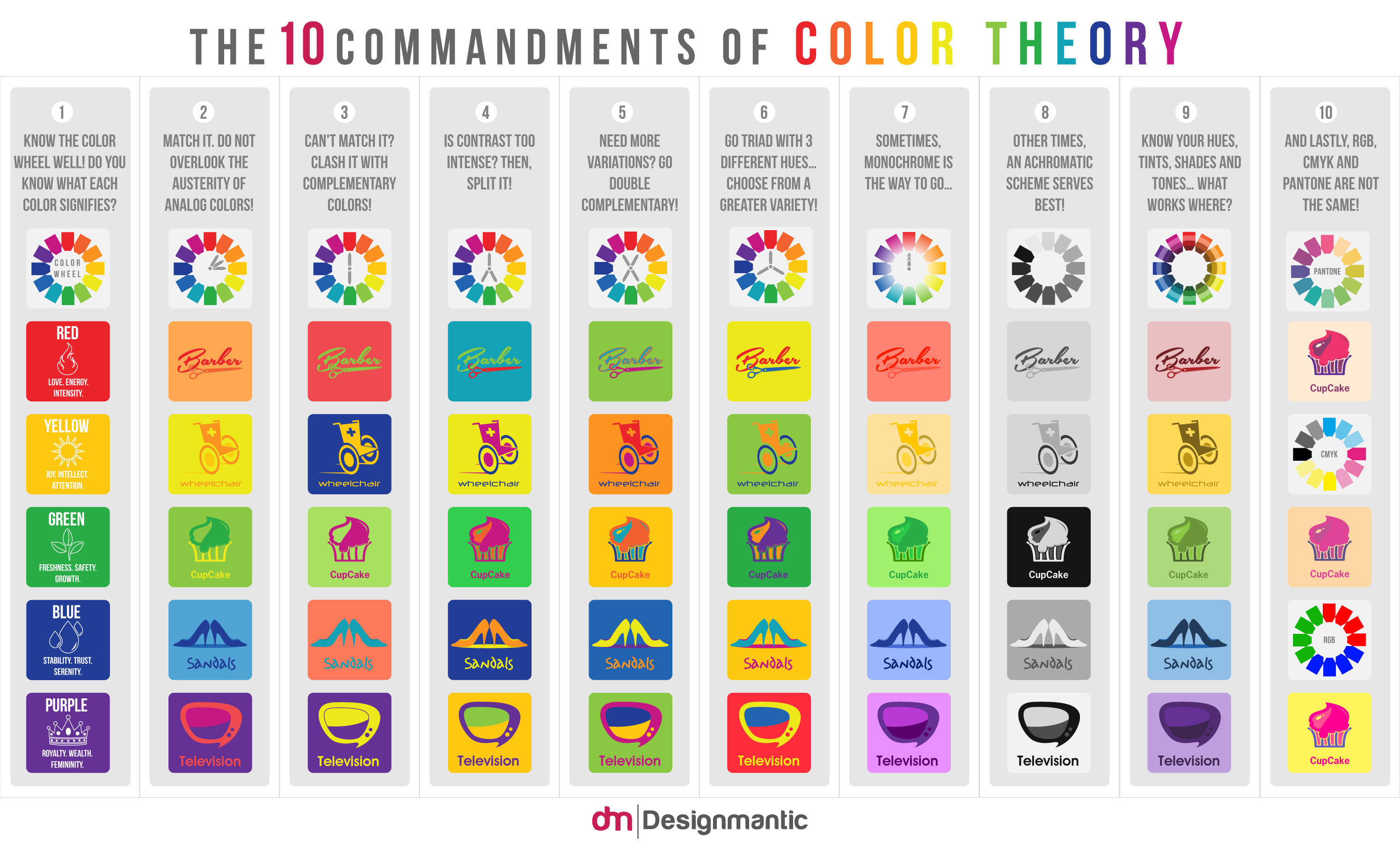
People designing brochures and adverts and a new color scheme for the living room might find some new thoughts in this infographic on color theory from designmantic. It includes the basic “meanings” attributed to each color and how colors can be combined successfully, for those throw pillows and whatnot.

Next time you look at a web page you particularly like, take a sec to see whether it’s because the color is just that exactly right shade of trustworthy blue. Thank you, Facebook.

P.S. Pantone’s “color of the year” for 2015 is Marsala, which the color company calls an earthy wine red that “enriches our minds, bodies and souls.” Looks like brown to me.

color, brown

(Frank Daugaard, flickr.com, CC license)