***The Storm Murders

farm, snow, winter

(photo: M Pincus, creative commons license)

By John Farrow – Farrow is the pen name that acclaimed Canadian writer Trevor Ferguson selected when he decided to try his hand at writing genre fiction, and, if I have this right, this is his fourth book featuring detective Émile Cinq-Mars and the first of a planned “storm murders” trilogy.

In this mystery/thriller, prickly retired Montreal Sergeant-Detective Cinq-Mars finds himself flattered and cajoled and inevitably drawn into helping in the investigation of a rural Quebec double-murder that culminated in the additional slaying of two young Sûreté du Québec police officers lured to the remote farmhouse by a phone call.

Perhaps Cinq-Mars decides to aid this investigation because he is intrigued by the crime itself, the lack of apparent motive, and the absence of the killer’s footprints in the newly fallen snow around the house. Perhaps it is the puzzling entreaties of a senior FBI agent, looking for answers in a case that’s way out of his jurisdiction. Perhaps it is the bleak persistence of a Canadian winter making the days weigh heavy on Cinq-Mars’s insufficiently occupied brain. Or perhaps it is his wife Sandra’s startling intimation that she might leave him, making the investigation a welcome preoccupation that might enable him to in some way resurrect the man she’d fallen in love with.

The FBI agent, frustratingly close-mouthed, at least reveals that the deaths of the Quebec couple share certain grisly similarities with a series of murders in the United States. All have involved a married couple, always they’ve occurred after a major calamity. As none of the neighbors know much about the couple, relatively new arrivals to the area, and in the hope of finding out more details that would suggest a connection among these deaths, Cinq-Mars travels to New Orleans. The first pair of murders occurred there, shortly after Hurricane Katrina. Sandra accompanies him, because the trip promises to be a semi-vacation. Both she and Cinq-Mars hope a change of marital venue will help them reconnect.

Booklist has called the Cinq-Mars books “the best series in crime fiction today,” and this is the first of them I’ve read. Farrow’s writing style, honed by writing literary fiction, is confident and sophisticated, and the book starts strong. In general, the characters and setting are interesting and well-developed, especially good-humored multi-racial NOPD detective Pascal Dupree and ambitious hotel security chief Everardo Flores, who enliven every scene they’re in. Unfortunately, the plot was not as robust as these other elements. I guessed early on (and I’m not a particularly insightful guesser) why the FBI was interested in this series of murders. Farrow receives praise from some reviewers for writing character-driven mysteries, but for my taste, Cinq-Mars’s examinations of his feelings about religion, his wife, and retirement are rather too long. The denouement also was drawn out past the point of believability, including both conversation and events that seemed unlikely.

While this book has much to recommend it, especially for admirers of the series, in the end it requires some suspension of disbelief.

A slightly longer version of this review appears—along with reviews of many new crime and thriller novels—at the Crime Fiction Lover website.

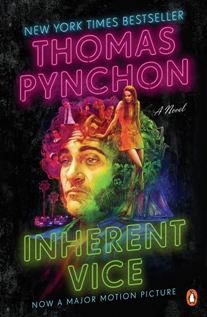
Inherent Vice

Inherent Vice, Joaquin Phoenix, Thomas PynchonWhen this film (trailer) of a Thomas Pynchon novel was released in 2014, critics said it was undoubtedly the ONLY Pynchon book that could be corralled into a film. I’m a big Pychon fan—loved V, The Crying of Lot 49, and Mason & Dixon—but I started Gravity’s Rainbow three times and never got past page 100. So I can sympathize with the difficulties director Paul Thomas Anderson must have faced.

Joaquin Phoenix plays “Doc” Sportell, a private investigator subject to regular harassment from a police detective called Bigfoot (Josh Brolin). Doc’s ex-girlfriend Shasta has taken up with a wealthy married property developer, and the developer’s wife wants her to cooperate in a plot to institutionalize him so she and her new boyfriend can raid his bank account. Then the magnate disappears. Doc uses is slight investigative skills to search for both the developer and Shasta in a stoner’s 1970s Southern California.

This set-up takes you down colorful and unexpected byways, which I couldn’t possibly reconstruct, and a multitude of stars provide performance gems: Owen Wilson as a mixed up dude-dad, afraid to leave the drug cult that’s captured him; Hong Chau as the hilariously matter-of-fact operator of a kinky sex club; Martin Short as a cradle-robbing dentist, with his clinic in a building shaped like a golden fang; Golden Fang itself, a mysterious criminal operation that . . . None of this probably matters. Neo-Nazi biker gangs, yogic meditation, stoners. You just have to go with it. Joaquin Phoenix, understandably, displays about a zillion different ways of looking confused.

If you have a taste for the absurd and what Movie Talk’s Jason Best calls “freewheeling spirit,” this is definitely the movie for you! I try to guess whether audiences or critics will like a movie better. Right on the money this time: Rotten Tomatoes Critics Rating: 73%; audiences, 53%.

***Jack of Spades

playing card, Jack of Spades

(photo: Poker Photos, creative commons license)

By Joyce Carol Oates – This rather short (200-page) new psychological thriller is told as a first-person narrative by successful mystery author “Andrew J. Rush.” Rush thinks of himself with quote marks around his name, perhaps because he’s beginning to realize identity is more ephemeral than he’s heretofore believed. The reader soon learns he’s begun secretly writing a new series of books under the pseudonym “Jack of Spades.” These books are an exceptionally dark, crude, and surprisingly popular [!] departure from AJR’s usual output. Worse, writing books under his own name is laborious, whereas Jack of Spades books fly onto the page from the tip of his pen.

AJR is one of those intriguing characters, the unreliable narrator. He is self-obsessed, but not self-aware. The reader realizes immediately that, given a choice between behavior that makes sense and behavior that will get him into trouble, he will choose trouble every time. When a woman from the local community launches a baseless plagiarism suit against him, he has two choices: a) call his publisher’s legal department; or b) telephone the woman and try to reason with her. You or I would lawyer up. AJR, of course, chooses b), which leads to a frightful scene.

It turns out this plaintiff is slightly unhinged, with a history of suing prominent authors for stealing her outlines and ideas—she’s even sued Stephen King, his lawyer tells him—and the court readily dismisses her complaint. But AJR can’t let it go; he becomes obsessed with her. Added to this is the increasingly insistent voice of Jack of Spades who, like a malevolent Jiminy Cricket, goads AJR toward further steps in all the wrong directions.

Early in the book, the dogged plaintiff reminded me of the fangirl-turned-vicious in Stephen King’s Misery. (Although Oates takes her novel in a different direction, the King thriller must have been in her mind, too, because she includes a reference to it.) Strangely energized by his growing fears, it is AJR who repeatedly courts a confrontation with his litigious nemesis, escalations conveyed vividly in Oates’s tension-filled writing.

This being a novel whose narrator is an author, it includes some early passages disguised as notes on craft that are actually deft foreshadowing. AJR is discussing the structure of the book he is currently working on and how he plans to include a contrasting “hero” and “villain” in alternating chapters, with the hero prevailing in the end. AJR and the asides from the Jack of Spades play those contrapuntal roles, as well. His planned final punishment of the villain is part of the implicit contract between mystery authors and their readers that allows for “an ending that is both plausible and unexpected.” If there’s a flaw in Oates’s book, it is that the ending falls short of that goal.

By making the narrator a somewhat high-brow mystery writer, Oates can quite naturally adopt a voice for the book that reveals a great deal about AJR in its pretentiousness and deprecating attitude regarding his wife and certainly the townspeople. As a reader, you probably won’t like AJR, but it’s delicious to see such a creep get himself into deeper and deeper trouble. It’s too bad he takes others with him.

A slightly longer version of this review appeared on the Crime Fiction Lover website.

**The French Detective: A Novel of New Orleans in 1900

New Orleans, French Quarter

(photo: David Ohmer, Creative Commons license)

By O’Neil De Noux – A jambalaya of factors go into a reader’s enjoyment of a crime novel, and this one is definitely a (mostly) flavorful mix. De Noux has selected a time and place ripe for drama. New Orleans is consistently intriguing on many levels, most particularly for its diversity of strong cultures stewing together in the oppressive Louisiana heat. The time period, the turn of the last century, is filled with dramatic possibility, because of the city’s changing demographics and because of the real-life occurrence of the Robert Charles race riots, which De Noux draws into his story.

The challenges to New Orleans Police Detective Jacques Dugas begin when a four-year-old boy is kidnapped from the city’s Vieux Carré, at this point in its history an Italian and Sicilian district. Mostly recent immigrants, the residents have little use for the police and cooperation is scant, even when Dugas has the volunteer translating assistance of glamorous young Evelyn Dominici—Italian-speaking daughter of a Corsican jeweler and an English Lady. The Corsican is a New Orleans resident, but Lady Evelyn’s mother lives in England, ensconced in a drafty castle with her lover.

Dugas and his translator, rapidly falling for each other and flirting outrageously, pursue the many potential leads in the case until the investigation is derailed by the riots. The book is populated with white supremacists, Italian citizens committees, Sicilian mafia, Irish cops, and, always at the fringes, the blacks and the poor. Jambalaya. One delicious aspect of the book is how often Dugas, Evelyn Dominici, and their colleagues must stop to eat. Reading this book is enough to make the reader put on five pounds by literary osmosis.

Yet all is not well-served in this literary endeavor. This is a self-published book, which to me means the author-as-publisher takes on extra responsibilities. While De Noux attempts to absolve himself from any errors via a note saying “If you found a typo or two in the book, please don’t hold it against us. We are a small group of volunteers . . .” There are many, many more than a typo or two. The writer’s role, as John Gardner had it, is to create a fictional dream in which writer and reader are co-conspirators. Keep the dream going, and the reader continues to believe in the story created. Tyops wake you up.

Such lack of attention cannot help but make the reader wonder about the care expended on plot, characterization, and other literary matters. In this book, the plot raced hither and yon so often, I occasionally lost the thread, and it left loose ends (who wrote all those notes?). The character of Evelyn was, to me, unbelievable in her liberated attitudes for a woman of that era and an English Lady, no less. Nor was the attention devoted to the attractiveness of her figure interesting on a sustained basis.

Nevertheless, I actually enjoyed this book on its own terms, as a window into a pivotal time in one of America’s most fascinating cities.

A longer version of this review is available here on the Crime Fiction Lover website.

****Gun Street Girl

Ireland, street scene, Belfast

Belfast street (photo: Recuerdos de Pandora, Creative Commons license)

By Adrian McKinty, narrated by Gerard Doyle Gun Street Girl takes place in Belfast, in the mid-1980s, and The Troubles provide a fine backdrop of tension and mayhem. It’s the fourth (yes!) of a planned trilogy, because McKinty—and his readers—couldn’t quite let Detective Sean Duffy go.

The complex plot grows out of actual events of the era, including missile thefts from aerospace company Short Brothers (a convoluted affair in real life) and the hostile environment created by the Thatcher-FitzGerald Anglo-Irish agreement. In the novel, Duffy is out of step as usual with his confreres in law enforcement, especially for being the rare Catholic in the Royal Ulster Constabulary. When a murder investigation takes Duffy and a new recruit to Oxford, England, they encounter a more generalized anti-Irish prejudice. The British coppers apparently believe the Irishmen will be satisfied to sit in their cozy b&b in Oxford (unless my ears mistook, referred to as “Morse-land,” in a nice homage) and drink whiskey. They are, of course, mistaken.

What has taken them to Oxford is the unraveling of a case that at first appears open-and-shut. A couple is found murdered, and it looks as if their son shot them then committed suicide. Under Duffy’s supervision, Detective Sergeant McCrabban is technically in charge of this investigation and is ready to close the books on it, but something’s not quite right. For one thing, no one really wants Duffy and McCrabban poking around in it.

Meanwhile, Duffy’s future with the R.U.C. faces an almost-certain dead-end, and MI5 agent Kate tries to recruit him for her agency. All things considered, a change of employer is more than a wee bit tempting. She’s the Gun Street girl, and, as Tom Waits would have it, Duffy will “never kiss a Gun Street girl again.”

Doyle has won numerous Earphones Awards from AudioFile, and has a solid history narrating mysteries and thrillers. In this book, he must present various Irish and English accents and does so beautifully. I could listen to the book again just to hear him read it. Detective Duffy’s voice is crucial, since the story is told in first-person narration, and Doyle captures him—and McKinty’s dry, self-deprecating humor—beautifully.

A longer version of this review is available on the Crime Fiction Lover website.

A Most Violent Year

Oscar Isaac, A Most Violent YearMissed this December 2014 crime drama (trailer) in theaters, but finally had a chance to watch it on the small screen. Oscar Isaac, who was quite likable in Inside Llewyn Davis and even stronger here, does a fine job as Abel Morales, head of a New York City heating oil company; Jessica Chastain, always good, plays his wife. Morales’s trucks are being hijacked and his drivers beaten up by—who?—shady competitors, ambitious freelancers, organized crime? With his drivers and sales people at risk, the default of everyone around him is to arm themselves (which makes for some pretty scary scenarios in city traffic), but Morales resists.

He wants to remain an upstanding businessman, to keep taking the high road despite the growing chaos around him. This includes a lengthy and apparently stalled investigation by the city prosecutor (David Oyelowo) of financial sins in the heating oil industry and Morales’s company in particular. Morales is aided in his endeavors by the somewhat ambiguous character of his lawyer (Albert Brooks) who has the patience for long negotiations. As one protracted land acquisition looks about to successfully conclude, the other difficulties piling up put it out of reach again.

What was solid about this movie was that the business dealings seemed plausible and important, not just made up in the usual Hollywood way. The film was written and directed by J. C. Chandor, and in our cynical epoch of anti-heroes, he’s made Morales someone you want to see succeed. “There’s less violence that you would expect, given the film’s title, but the scenes of moral suspense prove just as breathtaking as the episodes of physical jeopardy,” said Jason Best in Movie Talk.

The plot took unexpected turns until the final resolution, and, whatever, viewers have many chances to see the most beautiful (and magically dirt-shedding) camel-hair coat ever!

Nice Rotten Tomatoes critics’ rating of 90%; audiences 70%. The film garnered numerous awards and award nominations, as did the acting and directing.

****The White Van

police, San Francisco, passersby

(photo: Thomas Hawk, Creative Commons license)

By Patrick Hoffman — This is a story about what happens when people get in way, way over their heads. At its center is 31-year-old Emily Rosario, a down-on-her-luck San Francisco woman living on society’s sharp edges. “She was pretty, but in a beat-up way. She would have been prettier in a different life.” One with fewer drugs and kinder men.

The story opens with Emily being picked up in a Tenderloin district dive bar. The Russian man who approaches her, doesn’t look dangerous. He has money, he’s clean. And he has crack. With these thin rationalizations, she accompanies him to his hotel near the airport. Soon she’s being fed more drugs than she’s bargained for. Three Russians keep her for a week in a state of semi-stupefaction, then, still foggy, send her into a bank to carry off the pretense of a robbery. Now in possession of a satchel containing $880,000, she stumbles out of the bank, but instead of climbing into the robbers’ waiting white van, she steps back into the bank, nabs the security guard’s gun, and sends him running. Confused, with sirens approaching, the van driver takes off. Emily emerges and runs away. The robbers have lost her and, of infinitely greater concern, the cash.

Meanwhile, Leo Elias and his younger partner Gary Trammell, members of the SFPD’s Gang Task Force cruise the streets. Elias’s recent string of lousy financial decisions is fast catching up with him. This robbery seems to Elias like a crime he might be able to solve. And in solving it, he means to steal the money for himself. Elias draws Trammell in, and as they sink deeper and deeper into a case they have no authority to investigate, Elias acts crazier and crazier. Trammell, unsure what to do, decides to just go along, at least for a while.

Emily can’t quite make up her mind to leave San Francisco, but the Russians and the two increasingly desperate cops are on her trail. A private detective has staked out her crib, and if any of her neighbors even suspect what’s in that bag she never lets out of her sight, her life will be over in a finger-snap.

Saying much more would spoil Patrick Hoffman’s well-planned plot twists, but suffice it to say, they keep coming. He has lived in San Francisco and worked as an investigator, and his knowledge of the city and its geography, his familiarity with police procedures, and—even better—his understanding of police attitudes is totally convincing. Here’s an example: “Delgado [the police union representative] leaned toward Elias and whispered, ‘There were a couple cameras in the alley, but none of them caught the incident. Which is to say, your memory of what happened is the correct version.’” He also understands the psychology of people in trouble. Through his obsessive attention to their state of mind, he puts readers right in both Elias’s and Emily’s heads as the tension and the stakes continue to mount.

This terrific debut novel is a true page-turner. Start reading this book and you won’t want to stop.

A longer version of this review is available on the Crime Fiction Lover website.

****Hold the Dark

arctic wolf

(photo: myri-_bonnie, Creative Commons license)

By William Giraldi, narrated by Richard Ferrone. This crime thriller set in the remote villages and tundra of Alaska lays bare different visions of civilization. The inhabitants of remote Keelut have their own ways of doing things—of dealing with birth, and death, and grief—and no matter how strong the forces of conventional culture are, in the end, the old ways win. In the process, the book “peels away the thin membrane that separates entertainment from art, and nature from civilization,” said reviewer Alan Cheuse in the Boston Globe.

Russell Core is a nature writer and an expert on wolves, with a famous book about them. When wolves take two, then three children from Keelut, the mother of the third child, a six-year-old boy named Bailey, asks him to come help her understand what is happening. Untethered from family and any part of life he finds meaningful, Core responds to her plea, and is drawn deeper and deeper into the lives, ways, and secrets of the remote village. The child’s mother, Medora Slone is married, but her husband Vernon has joined the military, fighting in Iraq or Afghanistan, this nation’s “desert wars.” Do not assume this has made a regular American of him.

Yet Slone is described as a renegade, and Core wonders how this squares with life as a soldier. His best friend, an Alaska Native named Cheeon says Slone can make himself look like he is doing what he is supposed to, but will be doing what he wants to, nonetheless. Cheeon did not join the military for that reason. He hadn’t that gift.

When Slone returns to find his son dead and his wife missing, well, in the classic crime novel vernacular, “all hell breaks loose.” Hell, in this case, plays out during the year’s longest nights—18 hours of darkness—and over a tundra so vast “whole states could fit on its frozen breadth.” The weather is practically another character in this frozen terrain: “Like grief, cold is an absence that takes up space. Winter wants the soul and bores into the body to get it.” Before this book is through quite a few souls fall to the cold, the wolves, and the people.

Richard Ferrone’s narration perfectly fits the other-worldliness of the Alaska Natives and the care with which residents of the far north must operate in their unforgiving environment. Giraldi is the fiction editor of Boston University’s literary magazine Agni.

Left-wing Crime and Right-wing Thrillers?

hawk

(photo: pixabay)

A recent essay in The Guardian by Scottish crime fiction writer Val McDermid suggested a key difference in the subtext of crime fiction versus thrillers. McDermid had attended an international crime writers’ conference in Lyon, France, a country where people are “deeply interested in is the place of politics in literature,” by both long tradition (think Emile Zola and Victor Hugo) and current trends. It’s hard for politics not to be top-of-mind for many French people because, as in much of Europe, right-wing parties are making gains that would have been inconceivable in the years immediately following World War II.

The political undertone of crime novels is typically left-leaning, says McDermid, when they are “critical of the status quo, sometimes overtly, sometimes more subtly.” They often reveal corruption in City Hall or police departments. Moreover, they explore characters who do not fit easily into society. Even when the perpetrators are high-status, they harbor a shameful and destructive secret (The Girl with the Dragon Tattoo). More often, their characters emerge from society’s ragged fringes. Henning Mankell departed from his usual focus on crime to write specifically about these disenfranchised in his novel, The Shadow Girls.

By contrast, the political point of view of a thriller “tends towards the conservative,” McDermid suggests, “probably because the threat implicit in the thriller is the world turned upside down, the idea of being stripped of what matters to you.” Good examples are found in the work of Frederick Forsyth (The Day of the Jackal, The Avenger), Tom Clancy (Patriot Games, The Hunt for Red October).

In the end, readers of the thriller genre expect a significant return toward normalcy, despite the typical last-chapter carnage. While some criminals may be brought to justice by the end of a crime novel and the city put back in order, it isn’t always, and the reader is left with a feeling of more to come. This is in part because good crime writers—like George Pelecanos or Michael Connelly—ground their work in real problems, and these real problems are not easy to solve.

This is not to conflate the personal politics of the author with the underlying thrust of their books’ genre, as does the rebuttal essay linked below. Plenty of thriller authors have liberal personal politics, and plenty do not. Moreover, while differing world views may influence what authors write or whom they pick to be their villain, the more popular and successful writers generally keep their political opinions on the back burner. Even so, “our views generally slip into our work precisely because they are our views, because they inform our perspective and because they’re how we interpret the world,” she says. With all the inevitable exceptions to McDermid’s formulation, it makes for a thought-provoking rule-of-thumb.

Crime Scene 101

Television and the movies notoriously overstate the tools (especially the electronic ones) at a criminal investigator’s command, to the extent juries have developed increased expectations about the availability of forensic evidence. (Here’s a fascinating study of the “CSI Effect,” suggesting prosecutors and judges need to up their game.) At the same time, many writers of crime thrillers strive to accurately portray crime scene investigations and to make their fictional detectives follow more careful procedures than often occurs in real life.

crime scene investigation

(photo: U.S. Army, Europe, creative commons license)

Forensic investigator Geoff Symon recently talked to crime authors about evidence. He began by dividing it into two categories:

  • direct evidence, which means eye-witness accounts, with all their well-documented weaknesses and
  • circumstantial evidence, which is everything else.

Symon emphasized that circumstantial evidence is still evidence, and when a tv lawyer pooh-poohs a case, saying “it’s only circumstantial,” that’s not necessarily a weakness. In truth, unless there is a reliable eye-witness, all cases are circumstantial. Fingerprints, hairs, fibers, and blood and DNA other than the victim’s are all circumstantial evidence, and the accumulation of evidence of this type, when put together in a convincing narrative, can become absolutely compelling. Circumstantial evidence can relate to a particular category of people (say, all those with blood type AB negative or having a carpet with a particular kind of fiber), or to a particular individual (fingerprints or DNA).

Says Adam Plantinga in 400 Things Cops Know says “People watch crime shows on TV so they think the police can get readable prints off just about anything—human skin, stucco walls, quesadillas,” but “only a few surfaces are conducive to the retrieval of fingerprints.” Slick surfaces, like noncoated glass, glossy paper, and aluminum are best, he says.

Two additional considerations are avoiding contamination of the crime scene and maintaining the chain of evidence. No longer do hordes of people enter the room where a body lays, tromp around in their own shoes, and depart. (In the notorious 1954 murder of Marilyn Sheppard, “Police officers, relatives, press, and neighbors [were allowed to] troop through the house.” Subsequently, this case was a basis for the movie and tv series, The Fugitive.)

Today’s investigators recognize that “whenever you leave a room you take something with you and you leave something behind,” Symon said. Thus, the importance of hair coverings, gloves, booties, and hazmat-looking suits. Cross-contamination of the crime scene was vital to the defense of O.J. Simpson. First investigators on the scene, therefore, have a particular responsibility to document it accurately with photos, video, sketches, and notes, knowing it may be contaminated subsequently.

Similarly, the chain of custody for evidence is an essential part of “preserving” the crime scene evidence. Unless a piece of evidence has been carefully tagged, and each subsequent person who handled and tested it has signed for it, criminal prosecutors cannot claim that a trace of DNA , a hair, or other physical evidence is the same bit gathered at the crime scene and not somehow introduced subsequently.

Symon and other forensic investigators help authors by describing “reality.” The challenge for the author is to subvert reality in a believable way so their story’s plot can unfold. While in real life, procedural mess-ups may mean perpetrators are never be brought to justice, this often suits the author’s fictional purposes very well.