By now you may have heard of the Shirley family’s reservations about director Peter Farrelly’s movie, despite its winning a Golden Globe for best motion picture (trailer). Based on a true story, the script was written by Nick Vallelonga, Peter Farrelly, and Brian Currie, who won a Golden Globe for best screenplay
There’s no faulting the acting, Mahershala Ali (Golden Globe)
portraying sophisticated jazz pianist Don Shirley, and Viggo Mortensen as his rough-around-the-edges
and racist chauffeur, (Nick Vallelonga in real life), are both tops.
They embark on a concert tour of the Deep South in the early
1960s, before the Civil Rights movement, and encounter all the expected
restrictions, slights, and prejudices. And that was part of the problem. I’d
already imagined, known about, and seen these situations in many other films back
when this type of content was an eye-opener.
I fear it gives today’s white people a too-easy win,
encouraging us to think “I’m sure glad I’m not like those Southern racists.” Racism
can’t be just put in a drawer as if a piece of the past that no longer needs
attention. Black Americans traveling today still
encounter racism.
Perhaps a new generation needs these reminders, and perhaps younger
people will take from the film the powerful lesson that connection and friendship
and respect can grow between people who are so unlike each other. That’s
something to hope for.Rotten Tomatoes critics
rating: 81%; audiences 94%.
On the Basis of Sex
Having seen and enjoyed the documentary RBG, I was prepared
tro be disappointed in Hollywood’s version of Ruth Bader Ginsburg’s career, directed
by Mimi Leder with a script by Daniel Stiepleman (trailer). To my delight,
I was not. Felicity Jones as RBG and Armie Hammer as her devoted and amazingly
patient husband Marty do a fine job, Mel Wulf (Justin Theroux) of the ACLU is
busy being political, and the courts are against her, but Ruth soldiers on to
victory (as we know beforehand). I particularly liked the scene where opposing counsel
waved a list of the hundreds of U.S. statutes that applied differently to women,
thinking to show how “normal” the practice was, and RBG instead used it to show
the practice was pervasive and pernicious.
Haven’t heard of this one? Me neither, until I found it in the Academy Award shortlist of nominees for song and music. This Coen Brothers experiment appeared ever-so-briefly in theaters then went straight to Netflix (trailer).
It’s an anthology of six short stories, alike only in the brothers’ trademark dark vision and black humor, and it won the best screenplay award at the Venice International Film Festival. There’s music too, of the cowboy lament variety.
Each of the six tales has its own cast, including Tim Blake
Nelson (Buster Scruggs), Liam Neeson, James Franco, Brendan Gleeson, Zoe Kazan,
Tyne Daly, Tom Waits, and Bill Heck.
There is violence, of course, but most of it is cartoonish. While there’s humor, there’s wistful sadness as well. Most memorable, I think, is the story “Meal Ticket,” in which a young man with no arms and legs but a wonderful voice for oratory (Harry Melling) performs for a dwindling audience of shantytown residents. In the story, “All Gold Canyon,” featuring Tom Waits, you’ll see the most beautiful valley imaginable.Rotten Tomatoes critics rating: 92%; audiences: 77%
When Bruce Pritchard unlocked the door to his weekend Cape May, New Jersey, cottage one Friday early in June, the wind crowded in behind him like a presence, gusts of rain snapping at his heels. He flipped the light switch and shed the old-fashioned boots, oilskins, and sou’wester he affected, a fully wired city boy summoning the crusty New England sea captains of his imagination.
He lit the fireplace to exorcise
the weekday shadows and dispel the ocean’s powerful breath, swirling about him
like a salt-tinged mist. In the kitchen, he unpacked provisions — steaks for
friends, a purple cluster of mussels for himself, a bottle of prosecco, ditto.
This he opened at once.
He toured the four downstairs
rooms, glass of wine in hand, shedding the week’s frustrations like a sodden
overcoat. The cottage’s renovations were finally, finally finished, and the
next evening his six best friends — and investment clients — were driving down
from New York to help him celebrate.
A line of sand-clouded puddles
tracked from door to fireplace disturbed the perfection of the moment, and
Bruce chided himself as he fetched a towel to dry them.
After dinner, he sat in front of
the fire and paged through a musty volume of nautical prints — oversized
engravings of merchant ships, three-masted clippers, an artist’s impression of
The Flying Dutchman. Tonight he’d skip the blood-soaked ghosts of the Stephen
King he’d been reading, the book slumbering like a serpent on his beside table.
He’d rescued the book of engravings
from the attic, a farrago of yellowing volumes, framed pictures, half-empty
chests, and broken whatnots he’d barely glanced at as yet. The elderly sisters
who sold him the cottage said they’d never been up there and exchanged a
secretive look. “Noises,” one said, and the other said, “Best not to be too
curious.” “Or disturb things,” the first one nodded, but her sister cut off
further comment with one glance. Of course they didn’t want to call attention
to how they’d left everything “undisturbed,” and unrepaired, and unpainted, un,
un, un, which was why the place was crumbling around their ears and why he’d
been able to buy it at such a good price.
Well into the night, the storm
provided a soundtrack for dreams of howling seas and wind-battered sailors,
decks slippery as glass, whiplashing ropes and renting sails, so that he awoke
feeling he’d tussled with the elements for hours. From the bedroom window, he
watched the morning sun chase the ocean waves, a quarter-mile away. His prize
view.
Mary Benaker’s station wagon pulled
into the smoothed patch of sand next to his BMW. He threw on a robe and met her
at the front door. Mary was the real estate agent who kept an eye on the place
for him, arranged his cleaning service, and oversaw any weekday workmen. She’d
been a godsend during the renovation. All 18 harrowing months of it. Now she
greeted him, holding a flat of annuals.
“Thought you might want these,” she
said, too cheerful for the hour. “I just drove past the farmer’s market.
They’ve got strawberries.”
Bruce regarded the banal mix of
orange marigolds, red salvia, and purple and white petunias. Nothing he would
plant. Certainly not in that color combination. “No thanks. I’m headed to the
garden center today myself. Very generous of you, but, no.”
She looked a bit sadly at the
unwanted annuals, but said nothing.
As an afterthought, he said, “One
thing, though. Was the maid service here last week?”
“Next week. First and third
Wednesdays. Everything OK?”
He looked past her, head cocked.
“Yes, but …” He paused to focus a thought. “Everything looks moved, slightly,
like someone dusted. And, it just feels like … someone’s been here.” He’d had
a parade of unsettling feelings when at the house in the last few weeks, but he
wasn’t going to tell Mary about the worst of them — that someone was watching
him. That he chalked up to urban paranoia and, possibly, too much Cabernet.
Now she hesitated. “Anything
missing?”
“Nothing like that. Probably my
imagination.” The uncertain way he said this made it clear he didn’t believe it
was his imagination at all, and he turned to go back inside the house. “Thanks,
anyway.” He indicated the plants.
“Suit yourself,” she said to the
closing door.
Bruce leaned his back against the
door, annoyed. Throughout the endless renovation, she always managed to slip in
a dig. “If that’s what you like,” “Of course, that’s up to you,” “Suit
yourself.” Her distaste for his choices, his polished style couldn’t be
clearer.
“So what!” he scolded himself, then
gasped. He took a step forward, then another, transfixed by what he saw over
the fireplace. In place of his prized large-format Robert Mapplethorpe
photograph — ambiguous portions of two male torsos, one black, one white, so
rich in tone it seemed a color print, but wasn’t — sailed a four-masted
windjammer, sheets unfurled and running with the wind, straight at him.
He wheeled and opened the door.
“Mary!” he shouted, but the station wagon turned onto the road and disappeared
behind a stand of beach plums.
The frame of the Mapplethorpe
peeked above the back of a low sofa. He pulled it from its hiding place and
marched to the fireplace to switch the two. And stepped in a puddle of seawater
containing a miniature beach of sand and trailing a seaweed thread.
Maybe a shower would clear his
head. But in the bathroom, he found scrimshaw ornaments cluttering the glass
shelf. Where the hell did those come from? Figuring they were cheap plastic
souvenirs, someone’s idea of a joke, he picked up a piece to toss it into the
trash, and noticed the weight, the fine detail, a map he recognized as
Nantucket Island, and the date: 1846. He set it back on the glass and
contemplated it.
* * *
A piece of toast in one hand and
his smartphone in the other, he called Mary. “Who lived here before me, do you
know? Before the sisters.”
“Let me ask Chuck. If he doesn’t
know, he can find out.” Chuck Benaker was her husband, another realtor and a
past president of the county historic society. These combined interests could
generate a dizzying amount of genealogical detail about any parcel of local
property. Bruce found Chuck tiresome, but Mary was right. He’d know.
Bruce was planting herbs next to
the kitchen door when Mary called back.
“Chuck says your house was built by
a retired sea captain. This would have been about 1850. The house was in his
family for 75 years or so until the Darby family bought it. The parents died
soon after World War II, and they left it to their daughters — the sisters who
sold it to you. Not many owners.”
“What does he know about this sea
captain?”
“He said the historic society has
some papers and such. They open for the season in a couple of weeks, but wait.”
Mary put her hand over the receiver and spoke to someone. “Chuck says he can
meet you there about three.”
* * *
The historic society headquarters
and museum occupied a simple clapboard house on Washington Street. Chuck
Benaker looked up from a pile of mail. “So, your house? Quite a history.” He
handed Bruce a folder. “Captain Newsome was a true legend. You have there the
original deed to the property and records of some purchases. Stuff found after
he was murdered, I suppose. Plus the registries kept by his nephew, who lived
with him and let out the upstairs rooms to lodgers. The Darbys —”
“Murdered?”
“Newsome? Oh, yeah. Made enemies
like Dunkin’ makes Donuts. If he hadn’t died, he would have been charged with a
murder or two himself. Beat the rap by bleeding to death. The clippings are
here somewhere,” Chuck walked to a file cabinet and rattled a drawer open.
“We’ve been closed since fall, and the girls left everything a mess.” He
slammed the drawer. “But I remember the story.”
Bruce leafed through the folder,
mesmerized. So much for his house as a peaceful place, a refuge. He held up a
green feather.
“Ah. Newsome’s parrot, ‘Cap’n,’”
Chuck said. “According to their diaries, the Cape May ladies were more
terrified of Cap’n than of Newsome himself. Stunning vocabulary.
“Newsome was captain of a merchant
ship in the mid-1800s, sailed out of Massachusetts,” Chuck drawled, and Bruce
could see the rest of the afternoon unwinding drearily in front of him, despite
Chuck’s rendition of the despicable Newsome. Chuck pulled open the shallow
drawer of a map cabinet and located a floor plan of the house. “Carpenter’s
records.” He pointed to a second floor room. “Happened right there. When I
unearth the newspaper stories, you can read the police description. Strong
stomach?” He looked at Bruce over the top of his half-glasses.
“That’s my bedroom,” Bruce said,
staring at Chuck’s tapping finger.
“Really.” Chuck paused, as if he
found that fact somehow significant, and the word hung ambiguously in the air.
“Newsome and his killer, Henry Carver — now that was a prophetic name — had a
royal feud about your property. Came to a head one night, both of them drunk.
Carver tried to escape across the Pine Barrens, but a timber rattler got him,
so the police said.”
Bruce caught the skepticism. “You
don’t believe it?”
Benaker shrugged. “The other
lodgers didn’t believe it. The night in question they were all jammed in the
doorway of the murder room, but none of them lifted a hand while Carver did the
bloody deed. Newsome’s last words were, ‘I’ll come back and get you,’ and he
shook his fist at the lot of them. When Carver turned up dead, they hightailed
it.”
“What time is it?” Bruce startled,
as if wakened from a bad dream, and checked his watch. 5:30.
“Oh. Sorry to keep you.” Chuck
looked disappointed. “I get all wound up in these stories. Cape May County has
a colorful history, that’s for sure.”
Bruce stood up, a little wobbly
from information overload. “No, it was . . . helpful. But I have friends coming
at seven.”
“You go on. When I dig up those
clippings, we’ll talk again.” He rubbed his hands together, a gesture that made
Bruce wince.
Back at the cottage, The Windjammer
was back above the fireplace. He found the torn Mapplethorpe outside in the
trash barrel, frame and glass shattered.
* * *
Bruce’s guests said the cottage was
fantastic and thought the painting an inspired bit of camp. But their
admiration gave him no pleasure, and he was uncharacteristically quiet all
evening. He couldn’t talk to his New York friends about ghosts, then expect
them to invest their life savings with him.
He gave two of the men the “murder
room,” as Benaker termed it. As he stood in the doorway to point out the
switches and extra bedding, he began to shake, and he hurried back downstairs.
He slept on the sofa and hoped a sunny Sunday morning at the beach would
expunge Newsome’s gory phantom.
Too soon he was awakened by a
commotion in the kitchen. Up already before seven, his visitors prowled for
coffee. He found them clustered around the kitchen table, staring at a tall
bell-shaped object covered with a fitted cloth.
“Looks like my mother’s mixer,” said
one, “only bigger.”
“Your mother dressed her
appliances, too? I thought that was my Mom’s Midwestern chic.”
Bruce knew what the thing was. But
he lifted the cover, anyway.
“Cap’n’s back,” squawked the
parrot, followed by an outpouring of dark obscenities.
* * *
Late that afternoon the phone rang
in the Benaker real estate office, and Chuck picked up. “Hey, Bruce,” Chuck
said. He continued to listen for several minutes. “Sorry to hear that. . . .
No, I do not believe in . . .” He listened some more. “Well, OK, if you’re
sure.” Finally, he hung up.
He looked across the office and
smiled at his wife. “Your dream house? As good as yours.”
It’s the season to squeeze in viewings of prospective
Academy Award nominees. All four of these films and their cast members are in
contention. Nominations to be announced January 22, and the awards ceremony
will be February 24.
Vice
Word on the street is that this grim yet funny biopic, written and directed by Adam McKay (trailer), is slow. I didn’t find it so, absorbed as I was by McKay’s version of the dark mind and hollow soul of Dick Cheney, long-time Republican operative and George W. Bush’s vice-president.
Since everything is relative, we of short attention span might be tempted to look back on the Bush II Administration with some nostalgia, given . . . This movie is a bracing corrective to that impulse.
As Cheney, Christian Bale gets better and better as the film
progresses and Cheney ages, from an irresponsible drunk to master puppeteer—“resilient,
back-stabbing, front-stabbing, ruthlessly ambitious,” says Richard Roeper in the
Chicago Sun-Times. Early on, we see
the 9/11 scene in the White House situation room. (Our President, recall, was
reading to a bunch of schoolchildren when that catastrophe unfolded.) While all
the other national leaders sequestered in the White House basement are in
shock, the narrator says, Cheney “saw an opportunity.”
He saw another one when approached by W (Golden Globe winner
Sam Rockwell) to be his vice president. At first he demurs, but he recognizes
that Bush is a blank slate. The guy hasn’t a clue. Cheney does. And the
power-grab is on. Eventually, tasked with identifying a vice presidential
candidate, he identifies himself.
Amy Adams revels in her role as Lynne Cheney/Lady Macbeth, and
there’s even an apocryphal pillowtalk scene where she and Dick recite
Shakespeare’s lines to each other.
As he did in The Big Short, McKay breaks the
fourth wall to demonstrate what he’s suggesting with visuals puns and sly humor.
If this film is slow, it’s slow like a steamroller, flattening everything and
everyone in its path. Stay for the credits. There’s a bit more movie partway
thru.
Director Felix Van Groeningen’s film recreation of the
stories of David Sheff and his son Nic Sheff, and their family’s struggle
against Nic’s drug addiction is tough to watch (trailer). But only if
you’ve ever been the parent of a teenager or been a teenager yourself. There
are times and circumstances when parental love becomes unbearable for them all.
Although, like the relapses of addiction itself, the action occasionally
becomes repetitive, Steve Carell as the frantic father and Timothée Chalamet as
Nic are heartbreaking. Maura Tierny as Nic’s stepmom and Amy Ryan as his
biological mother provide powerful performances too.
An entertaining costume drama about three real-life women, directed by Yorgos Lanthimos and written by Deborah Davis and Tony McNamara (trailer). Poor Queen Anne (Olivia Colman) was truly a sad character in real life, plagued by ill health, and, despite 17 pregnancies, leaving no heir. Her reign was short (1702-1714), and she was a widow for half of it. Several strong women were her dueling confidants (Rachel Weisz and Emma Stone). Beautiful costumes, fantastic acting, especially by Colman. I wish the filmmaker had been drawn less to the rumors of lesbianism, which are discounted by many historians, and more to the politics of the time. It was in Queen Anne’s reign that Great Britain was formed, for example. Plus, the Worst Credits Ever.
Beautiful black and white photography in this highly praised
autobiographical movie written and directed by Alfonso Cuarón (trailer). And compelling
acting by the nonprofessional cast, particularly Yalitza Aparicio as Cleo, the
put-upon maid of a four-child household in domestic turmoil. She keeps them
together, literally and spiritually. I thought I’d read that she is
unappreciated, but she isn’t or perhaps the filmmaker is atoning for a lapse in
his own history. It’s pleasant and pretty but breaks no new ground—“quotidian
and extraordinary at the same time,” said Gary
M. Kramer in Salon.com. Now this
one is slow.Rotten Tomatoes critics’
rating: 96%; audiences: 83%.
An unexpected delight of my stumbling genealogy researches has been discovering and re-discovering my cousins. Most of my father’s family lived geographically close to me when I was growing up, but as far as getting to know them–they might as well have been a thousand miles away.
My dad was the son of Hungarian immigrants who came separately to the United States in the early 1900s, met, married, lived in Michigan where my grandfather was a farmer and an autoworker. They had 15 children, 11 of whom survived to adulthood. They didn’t talk about their immigration experience. At all.
Online research added to the
picture. The naturalization record for my grandfather, Ferencz Hegyi (with the
last name spelled six different ways on two government forms), provided the
date of his arrival and name of the ship he came on (the S.S. Chicago). He applied for naturalization after being in America
for some years, and it listed children’s names, leaving no doubt this record
was for my family.
From the ship manifest I found
his father’s name—Ferencz, or Frank, the same as his—and the village he came
from. Wow! My great-grandfather’s name and a definite place, Kondorfa. Still
today Kondorfa has only a few more than 600 residents. It’s in far western
Hungary, closer to Vienna and Bratislava than Budapest, in a German-Hungarian
area called the Burgenland. Short of learning to speak Magyar and traveling
there, my researches seemed to be bumping up against the proverbial brick wall.
One additional clue from the
ship manifest was that Ferencz’s destination was South Bethlehem, Pa. Probably
he planned to work at Bethlehem Steel, following in the footsteps of his older
brother. I found a 1923 death certificate for 38-year-old Peter Hegyi from
Kondorfa who died after being struck in the chest by a bar of steel. The
certificate listed his parents’ names, Ferencz Hegyi and Julianna Fabian. Now I
had my great-grandmother’s name too. But there my research string ran out.
In Your Genes
People ask me whether having a
genetic profile helps with genealogy, and I always say yes! I spit into a cup
for 23andMe many years ago. A couple of distant cousins on my mother’s side
have contacted me, all having useful connections and information. Then, a few
months ago, the surprise. A woman living near Bethlehem contacted me after
noting our slight genetic match and the Hegyi name, which is found frequently
in the area her family came from.
This distant cousin has website
Jane’s Genes (very useful general/tips, too), and some careful research on
Jane’s part revealed she’s my fifth cousin, once removed. Our common
ancestors are my great-great-great-great grandparents Janos Herczeg (b 1747)
and Rozalia Horvath (b 1755).
Jane has put me in touch with
other cousins in Pennsylvania and the Midwest. I learned one of my
grandfather’s younger sisters immigrated to South Bethlehem as well, and I’ve
connected with her granddaughter. Our Midwest cousin is another genius at
deciphering the spidery handwriting in the old Hungarian and Church records.
Thanks to her diligence, I can now trace my grandfather’s family back six
generations, to ancestors born in the early 1700s.
I’ve shared my written history
of the Hegyi family, sparse though it is, with about a dozen first
cousins—children of my father’s generation—and now regularly visit several of them
in Indiana and Michigan. I didn’t have addresses for them all, though, and
again 23andMe came through. The granddaughter of my Uncle Bill got in touch
and, through her, I’ve communicated with her mother, my first cousin.
When I started working on family history, what I expected to explore was “history”; now I’ve learned it’s about “family” too.
Don’t forget to watch “Finding Our Roots” on PBS Tuesdays, 8 p.m., hosted by Henry Louis Gates. Every family has a story!
Jon Barker, Erin Partin, and John Keabler; photo: Jerry Dalia
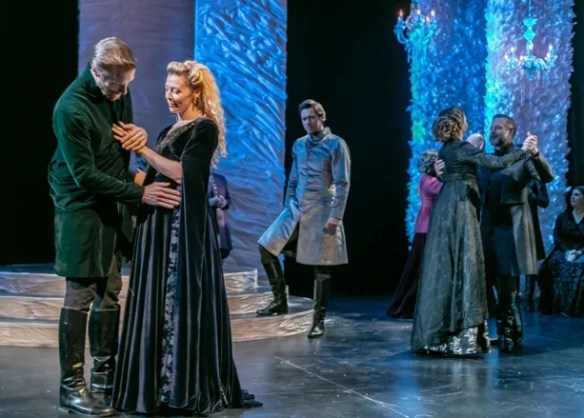
Shakespeare Theatre of New Jersey offers a powerful new production of The Winter’s Tale, a play that mixes darkness and light, the tragic and the playful. Directed by STNJ artistic director Bonnie J. Monte, it premiered December 8 and runs through December 30.
A cast of 20 is called upon to present Shakespeare’s story of how jealousy can overcome loyalty, friendship, judgment, how destructive it is to stick stubbornly to a belief despite all evidence to the contrary, and how, in the long run, the only redemption may be through love. Director Monte says this complex play is “part allegory, part searing drama, part pastoral comedy and part uplifting and moving romance.”
Leontes, King of Sicilia (played by Jon Barker), and his pregnant wife, Hermione (Erin Partin), are entertaining Leontes’s longtime friend from Bohemia, Polixines (John Keabler), when Leontes gets it in his head like a worm in an apple that Hermione and Polixines are more to each other than they ought to be. Learning the king means to do him harm, Polixines and Leontes’s courtier Camillo (Patrick Toon) flee Sicily, which only confirms Leontes of the couple’s guilt.
Leontes imprisons his distraught wife, who gives birth to a daughter that the wise woman Paulina (Marion Adler) begs him to see and claim, but he will not. He insists that his general Antigonus (Raphael Nash Thompson) take the baby away and leave it in some desolate place that it survive or die as the fates decree. Reluctantly, Antigonus complies.
Leontes puts his wife on trial, a proceeding interrupted by a message from the oracle of Apollo, who declares Hermione’s innocence. The message also says his son will die and Leontes will have no heir until he is reunited with his lost daughter. The death of the boy convinces him of the oracle’s truth, but the death of her son is too much for Hermione, and she too is struck dead.
Antigonus leaves the babe in a Bohemian wood and, in theater’s most famous stage direction, “exits, chased by a bear.” The infant is discovered by kindly shepherds.
Sixteen years pass, the character Time tells us, and the beautiful girl-child Perdita (Courtney McGowan) has fallen in love with Florizel (Ryan Woods), son of Polixines, though she does not know he’s a prince. The play moves into broad comedy with the country folk, but eventually the plan is made to go to Sicily, where sadness still reigns.There, everyone reunites and theater magic happens, and what was dark is made light again.
The entire cast is strong, with special mention needed for Jon Barker, who can convey every drop of meaning in Shakespeare’s lines through his delivery and unerring body language. Erin Partin and Marion Adler (who received applause for one particularly fiery speech) were also noteworthy. Seamus Mulcahy (Charley’s Aunt in the theater’s most recent production) shows his genius for physical comedy in the secondary role of shepherd. Raphael Nash Thompson and Patrick Toon provided restrained dignity in contrast to Barker’s erraticism.
A simple set is needed to accommodate two countries and numerous scenes, and Brittany Vasta has produced gorgeous, chilly white backgrounds that radiate winter and allow the beautiful costumes of Nikki Delhomme to provide the color. Other production credits to Tony Galaska (lighting), Danielle Liccardo (dance consultant), and Denise Cardarelli (production stage manager).
Shakespeare Theatre of New Jersey productions are hosted at Drew University in Madison, N.J. (easily reachable rom NYC by train). For tickets, call the box office at 973-408-5600 or visit the Box Office online. Note that STNJ offers special ticket pricing of $30 for theatergoers under age 30!
Woodrow Wilson’s house in Princeton cost about $35,000 to build and is now—rough-guessing here—worth about 100 times that — I learned this at a library benefit dinner at the actual house, featuring a talk by U-Mich professor Patricia O’Toole, who has a new Wilson biography: The Moralist. (Wilson promoted the neo-Tudor architectural style, and you see it all over town)
Just because an online course is about a subject I’m deeply interested in doesn’t mean the course itself will be interesting — learned during sessions 1 & 2 of a 3-part online course about genetics in genealogy
How to tell llamas and alpacas apart – at Jersey Shore Alpacas (e.g., llamas are bigger and have perkier ears)
There was a founding father before the Founding Fathers and, though the British called him “the greatest incendiary in all America,” he’s practically forgotten – a lecture at the fantastic David Library of the American Revolution by Christian di Spigna, author of Founding Martyr: The Life and Death of Dr.Joseph Warren
Not all NYC crime writers sport sleeve tattoos – disabused of this impression at the December Noir at the Bar readathon
It took about 1300 years for medical science to reacquire the knowledge lost when the Alexandria library complex was destroyed – adult ed course on Egypt
Ron Chernow (and thus the musical Hamilton) probably got a couple of the more risqué situations in his book wrong – also at the David Library, in a talk by Tilar Mazzeo, author of the new book, Eliza Hamilton
I may be exhibiting early manifestations of that old person’s “no filter” problem – you don’t want to know
The black stockings and tights I’ve been wearing since Thanksgiving are navy – daylight.
Greg Wood as Ebenezer Scrooge; photo: T. Charles Erickson
This is the third season for McCarter Theatre Center’s most recent and most joyous version of A Christmas Carol, its delightful return to Christmas in the Age of Dickens. Opening night was December 7, and this sparkler of a show, based on playwright David Thompson’s adaptation and directed by Adam Immerwahr, runs through December 29.
Immerwahr’s intent when he took on this holiday staple was to explore how Scrooge’s redemption “isn’t just the redemption of one man . . . when a person changes, it can transform an entire community.” His version is filled with songs from what Immerwahr calls “the treasure trove of terrific Christmas music of Dickens’s era.” Even some carols not used explicitly have “become part of the underscoring of the play,” whose music was composed by the late Obie-award winning composer Michael Friedman.
The show exemplifies McCarter’s goal of celebrating creativity, community, and diversity in the presence onstage—and before the curtain, in the lobby and theater aisles—of a cheerful community ensemble of 26 adults and a dozen children. The entire audience is involved in singing the opening carol, and probably no one in the audience avoided beaming and foot-tapping during the Fezziwigs’ Christmas party, with its exuberant, full-cast dance.
Ebenezer Scrooge (played by Greg Wood) has never said “Bah! Humbug!” with more feeling, Bob Cratchit (Jon Norman Schneider) has never been more patiently put-upon, and the rest of the cast, mostly playing multiple parts, is as lively as ever, bringing Dickens’s memorable characters wonderfully to life.
The familiar tale of a miser’s comeuppance is all there. The Ghost of Christmas Past reminds him how he gave up his youthful opportunities for happiness in order to pursue wealth; the Ghost of Christmas Present shows him how others, especially the Cratchits, live; and the Ghost of Christmas Future presents a frightening scenario that causes him to vow to change. Old Marley’s ghost (Frank X) is particularly effective and delivers my favorite line, the sententious “I wear the chain I forged in life.I made it link by link and yard by yard.” The early dark scenes change to light as Scrooge wakes Christmas morning a reformed man.
Underscoring the production’s goal of community engagement is the scheduling of a sensory-sensitive, relaxed matinee performance on December 28, to enable a wider range of people to enjoy a live performance. For tickets, call the box office at 609-258-2787 or visit the box office online.
Still looking for that perfect book for under the Christmas tree? Here are a few ideas for your weekend shopping that might suit some of the hard-to-buy for people on your list:
Film Noir Junkies – A.J. Finn filled his blockbuster psychological thriller, The Woman in the Window, with references to classic noir, and the main character watches quite a few too. And drinks Merlot by the case (trigger warning, Sideways fans).
Intrepid Travelers – if you can’t give a trip to Paris, you can give Mark Helprin’s Paris in the Present Tense. If they’re also classical music devotees, bonus points to you for finding this story about an aging cellist in the City of Light who really makes crime pay.
Jive-Talking Rap Music Lovers – Righteous or any of the other I.Q. books by Joe Ide. His characters’ language unspools across the page in pure urban poetry, as they solve crimes and right wrongs.
Unrepentant Bookworms – a book they can burrow into for days and maybe never sort out all the plot shenanigans, Lost Empress is about football, Rikers’ Island, a missing Salvador Dali painting, a man and his mom, transcribing 911 calls, Paterson, New Jersey, and so much, much more.
Armchair Psychologists – OK, does he have dementia or doesn’t he? Grace may not live long enough to find out on a Texas road trip with the elderly man she believes murdered her sister. Paper Ghosts is nice work from Julia Heaberlin.
Inveterate Classicists – David Hewson’s Juliet & Romeo is another in his fine adaptations of Shakespeare’s plays. Always inventive, always interesting. His Macbeth and Hamlet were winners too.
Road Warriors – She Rides Shotgun is Jordan Harper’s award-winning debut thriller about a man and his young daughter on the run. They won’t be able to turn the pages fast enough.
Fairy Tale Fans – True, they may be startled at the liberties Karen Dionne took with Hans Christian Anderson’s tale, but in The Marsh King’s Daughter, she’s created a compelling story of a girl raised off the grid and what it takes for her to build a conventional life. Can she keep it?
Anyone Who Just Likes a Damn Good Book – You should get a twofer for Philip Kerr’s book Prussian Blue, which does a deep dive into both the dark days of the Third Reich and early 1950s France. Detective Bernie Gunther’s skill at solving murders doesn’t always make him friends.
Shakespeare scholar Stephen Greenblatt made an absorbing presentation last week, here in Princeton, based on his new book, Tyrant: Shakespeare on Politics. What Shakespeare has to say about pretty much any domain of human behavior is worth thinking about, and Greenblatt’s current preoccupation was clearly shared by his receptive audience.
He edged into the topic by describing how Shakespeare has been used in many countries and settings as a screen on which people may project their views about their own leaders—views that very often would cost them their freedom or more, if stated directly. Shakespeare’s notable tyrants—Macbeth, Coriolanus, Lear, and, especially, Richard III—become stand-ins for narcissistic demagogues across time and geography.
He highlighted the would-be king (and real-life character) Jack Cade, who appears in 2 Henry VI, as a populist leader deploying eerily familiar tactics. In Shakespeare’s dialog, Cade makes blatantly absurd promises to the rabble he incites, to wit:
“There shall be in England seven half-penny loaves sold for a penny;
The three-hooped pot shall have ten hoops;
And I will make it a felony to drink small [weak] beer. . . .
There shall be no money; all shall eat and drink on my score;
And I will apparel them all in one livery,
That they may agree like brothers and worship me their lord.”
This peroration is followed by what Greenblatt supposed (correctly in my case) was the only line most people can quote from that particular play, “The first thing we do, let’s kill all the lawyers.” Greenblatt says that, while the cheering rabble could not have truly believed these extravagant promises, their support for Cade was unwavering. Not until scheming Macbeth is exposed as a regicide and murderer, does Malcolm regret his former loyalty, saying, “This tyrant, whose sole name blisters our tongues, was once thought honest.”
Shakespeare’s tyrants arise in eras when, as the book blurb summarizes, “Cherished institutions seem fragile, political classes are in disarray, economic misery fuels populist anger, people knowingly accept being lied to, partisan rancor dominates, spectacular indecency rules.” Such fraught times inspired Shakespeare, as did the tyrants’ narcissistic personalities and the “cynicism and opportunism of the various enablers and hangers-on” surrounding them. These same forces, personalities, and motives give his work continued relevance.
Greenblatt sounded a discouraging note in saying that, while Shakespeare was brilliant at portraying causes and effects in his history plays, he does not point a way to solutions. “There aren’t any good ones,” he said. Yet, remarkably, civilization survived these conflicts and setbacks. On a more positive note, he concluded that what Shakespeare also teaches us is, “We are not alone.”
As an Amazon Associate I earn from qualifying purchases—a few pennies to put in a jar to pay my WordPress bills. When you purchase this book by clicking on the photo above, you help me fill the jar. Thank you!
The trials of women authors are laid bare this season in several movies (The Wife, Colette), never more amusingly and heart-breakingly than in director Marielle Heller’s honest comedy-drama, written by Nicole Holofcener and Jeff Whitty, based on Lee Israel’s autobiography (trailer).
Melissa McCarthy is perfect as Lee Israel, a middle-ranking author of celebrity biographies in 1970s and 1980s New York, settling down into the ranks of the unpublishable. Lee can’t get her next project going—an unpromising, probably unsaleable biography of Fanny Brice. Her agent (Jane Curtin) won’t take her calls, her prickly personality has alienated any people who might have helped her, she’s behind in her rent and reduced to stealing a winter coat, and her cat is sick. Life is tough and so is she.
By chance, Lee stumbles upon a couple of original letters by Brice and sells them to the kind of antiquarian book dealers who trade in such collectibles. She soon learns bland doesn’t sell. What makes notables’ correspondence valuable is the personal touch, a bit of wit. She’s a writer; she can do this. And does.
Into her insular life arrives a comet of a man. Jack Hock, played with manic relish by Richard E. Grant, is Lee’s polar opposite. Gregarious and most probably homeless, he becomes her companion (the word “friend” would be tricky here), her drinking buddy, then her partner in crime.
The filmmakers initially saw Julianne Moore in the role of Lee, but they were so fortunate in casting McCarthy. Says Monica Castillo on RogerEbert.com, “The range in McCarthy’s performance cannot be overstated. At almost every turn, her character gives the audience plenty of reason not to like her. Yet, with Heller’s sympathetic approach and McCarthy’s acting, the movie humanizes her beyond caricature,” and Israel is presented with tremendous empathy and understanding.
Rotten Tomatoes critics’ rating: 98%; audiences: 86%.
As an Amazon Associate I earn from qualifying purchases—a few pennies to put in a jar to pay my WordPress bills. If you decide to read this book and click the photo above to order it, you’ll help me fill the jar.





 The trials of women authors are laid bare this season in several movies (The Wife, Colette), never more amusingly and heart-breakingly than in director Marielle Heller’s honest comedy-drama, written by Nicole Holofcener and Jeff Whitty, based on Lee Israel’s autobiography (
